
Creative Ways to Teach Friendship Skills to Kids
Table of Contents
- Why Friendship Skills Need Direct Teaching
- Books That Teach Kindness to Kids: A Low-Pressure Entry Point
- Social Emotional Learning Activities for Friendship at Home
- Role Playing Scenarios for Social Skills: Practicing Before It Counts
- Adapting Friendship Lessons for Neurodivergent Kids
- Digital Friendship and Online Safety Basics
- Conclusion: Small Moments Build Lasting Friendship Skills
- Frequently Asked Questions
Last Updated: September 10, 2026
Why Friendship Skills Need Direct Teaching
Friendship skills are the specific, teachable behaviors children use to start connections, share space, resolve disagreements, and keep relationships steady. Most parents assume these develop on their own once kids spend enough time together. They usually don't.
Kids who struggle socially rarely improve just by being told to "be nice." They improve when a caregiver names the skill, models it, and gives them a low-stakes place to practice. The approach below uses stories, games, scripts, and role-playing to turn empathy and cooperation into something a five-year-old can actually do.
The five strategies below work at the kitchen table, in the car, and on the living room floor, no classroom or curriculum required.
Books That Teach Kindness to Kids: A Low-Pressure Entry Point
Stories do the hard work for you. When a character faces a friendship dilemma, your child watches a problem unfold without the pressure of being personally involved, making it far easier to talk about what went wrong and what could have gone differently.
The Collaborative for Academic, Social, and Emotional Learning (CASEL) framework groups these abilities under social-emotional learning: self-awareness, self-management, social awareness, relationship skills, and responsible decision-making. A good picture book hits three or four of those in twenty pages.
Smokey D Baby Dogga builds its ten adventure-themed stories around exactly this territory. Smokey and her friends, including Rocky the Ghost Dog and Bella the Bat, hit the ordinary conflicts kids recognize: someone feels left out, a plan falls apart, a friend needs help. The Smokey D Baby Dogga Pirate Treasure Ship is a good starting point, since the plot hinges on teamwork and following clues together.

Choosing Stories With Friendship Dilemmas
Not every kind book is a useful teaching book. Look for a story where a character makes a choice with consequences.
- The problem is specific: exclusion, a broken promise, a disagreement over a game
- A character feels something clearly enough for your child to name it
- Someone repairs the situation, so your child sees resolution modeled, not just conflict
- There's a moment you can pause on and ask, "What would you do here?"
That pause is the entire lesson. Skip it and you've just read a nice book.
Social Emotional Learning Activities for Friendship at Home
Social emotional learning activities for friendship are structured, repeatable games and routines that let a child practice cooperation, turn-taking, and emotional regulation before a real social moment demands it. Structure matters more than the activity itself, and so does matching it to your child's developmental stage, since a game that works for a four-year-old will bore a ten-year-old into quitting.
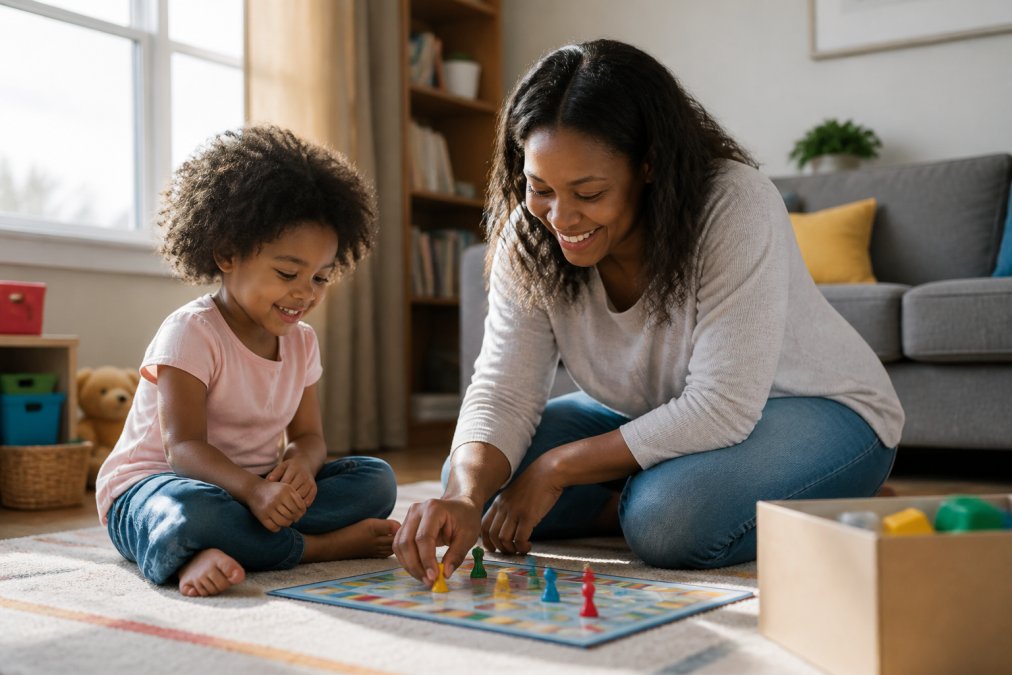
Match the Activity to the Developmental Stage
Most activity lists treat "kids" as one age. They aren't. Early childhood educators commonly segment friendship practice into three bands:
- Ages 2-4 (parallel play stage). Children play next to each other, not with each other. The target skill is sharing space and materials, not conversation. Use short, physical, adult-narrated activities.
- Ages 5-7 (associative play stage). Kids start trading roles and ideas but still need an adult nearby. The target skills are turn-taking, asking to join, and naming feelings.
- Ages 8-11 (cooperative play stage). Kids can hold a shared goal and negotiate rules. The target skills are compromise, repairing after conflict, and handling exclusion.
If you're not sure which band fits, the CDC guidance on child development and social milestones lists what's typical at each age. Pick the band below your child's age if they're struggling, easier wins build momentum.
Cooperative Games That Require Turn-Taking
Start with cooperative games where everyone wins or loses together. These remove the sting of individual defeat and force kids to pay attention to a partner. Try these in rough order of difficulty:
- Story round-robin (ages 3+). One person starts a sentence, the next adds to it. Nobody can end the story alone. This is the lowest-barrier entry point because there's no wrong answer.
- Freeze dance partners (ages 4+). When the music stops, find your partner and mirror their pose. Mirroring is a concrete, physical version of perspective-taking.
- Human knot (ages 6+). Three or four people hold hands in a tangle and work together to untangle without letting go. Requires negotiation and physical cooperation.
- Build-it-together (ages 5+). One child gives instructions, the other builds with blocks, then swap roles. Giving instructions requires perspective-taking; following them requires active listening.
That last one is the sneaky one. Most kids find one direction much harder than the other, and it's worth naming out loud: "Was it harder to give the directions or follow them?"
Facilitation Mechanics That Make the Game Work
The game is only the container. What you do before, during, and after teaches the skill.
- Before: Name the target skill in one sentence. "Today we're practicing waiting for your turn even when you really want to go."
- During: Stay quiet. Narrate only what you see, not what you want. "You're waiting. Your hands are still." Save corrections for after.
- After: Ask a feeling question, not a performance question. "How did it feel when you had to wait?" beats "Did you do a good job?"
- Repeat: Run the same game three or four times across a week. Novelty is the enemy of skill transfer.
Adaptations for Neurodivergent Kids
Standard activity advice assumes a child will pick up social rules by watching. Many neurodivergent kids won't, and telling them to "just pay attention" adds shame without adding skill. A few adjustments carry most of the weight:
- Name the rule explicitly. "When someone hands you a block, you say thank you", not "be polite."
- Teach one skill at a time and repeat it for weeks. Stacking skills too fast erases all of them.
- Use literal language. "Read the room" means nothing concrete. "Look at their face. Are they smiling or frowning?" does.
- Give a scripted phrase for when a child doesn't know what to say. A rehearsed sentence is a bridge, not a crutch.
- Practice in a quiet space before trying it somewhere busy. Sensory load competes with social load.
- Build in an exit. "If it gets too loud, you can come find me" lowers the cost of trying.
Role Playing Scenarios for Social Skills: Practicing Before It Counts
Role playing scenarios for social skills let a child rehearse a difficult moment in advance, so the words are ready when the real situation arrives. Rehearsal is why athletes run drills and actors run lines, the goal is to make the hard thing boring through repetition.
Set the scene in one sentence, assign roles, and keep it short, two minutes is plenty. Then swap so your child plays the other side. The swap is where most learning happens, because it forces your child to imagine what the other kid is thinking.
Sample Scripts for Joining a Group and Handling Conflict
Use these as written, then let your child adapt them. The lines are deliberately short, long scripts collapse under real-world pressure.
Joining a group at play:
Child: "That looks fun. Can I play too?" Other kid: "We're already playing." Child: "Okay. What if I'm on your team?"
Handling a conflict over a toy:
Child: "I was using that." Other kid: "I want a turn." Child: "Let's take turns. You go first, then me."
Responding to exclusion:
Child: "I feel left out when you don't include me." Other kid: "Sorry." Child: "Do you want to play something together now?"
The middle line matters most. Kids default to either giving up or getting loud. A rehearsed sentence gives them a third option.
Parent Coaching Scripts for Real Friendship Problems
Role-play is the rehearsal. Coaching is what you say when the real problem lands, at pickup, at bedtime, in the car after a birthday party. Most advice stops at "validate their feelings," which is step one, not the whole conversation. Here's a four-step sequence you can run in under five minutes.
Step 1, Acknowledge without fixing.
"That sounds really hard. Tell me what happened."
Resist jumping to solutions. A child who feels rushed will stop talking.
Step 2, Separate the event from the meaning.
"So she didn't save you a seat. What did you think that meant?"
Kids often leap from one event to a global story ("nobody likes me"). Naming the leap is the skill.
Step 3, Offer two or three options, not one answer.
"You could ask her at lunch tomorrow if she wants to sit together. Or you could sit with someone else and see what happens. Or you could do nothing and see if it was a one-time thing. Which one feels doable?"
Choices return control; one answer teaches dependence.
Step 4, Rehearse the chosen option once.
"Okay, let's practice what you'll say. I'll be her. Go."
This is where the role-play scripts above plug in, coaching and rehearsal are the same tool used at different moments.
What to Do When Your Child Is the One Who Hurt Someone
The harder conversation is when your child did the excluding, teasing, or promise-breaking. The instinct is to defend or punish. Neither teaches the skill.
"Tell me what happened from your side." "What do you think she felt?" "What could you do tomorrow to make it better?"
That last question is the one that builds repair skills. A child who learns that friendships survive mistakes, because someone repaired them, is a child who will take more social risks later.
Adapting Friendship Lessons for Neurodivergent Kids
Standard friendship advice often assumes a child will pick up social cues by watching. Many neurodivergent kids won't, and telling them to "just pay attention" adds shame without adding skill. What works instead is making the invisible visible.
Two approaches carry most of the weight. Social stories describe a specific situation step by step in plain language, so a child knows what to expect. Video modeling shows a short clip of a real interaction, letting a child study the non-verbal communication that's easy to miss in the moment.
A few adjustments that help:
- Name the rule explicitly instead of implying it
- Teach one skill at a time and repeat it for weeks
- Use literal language; "read the room" means nothing concrete
- Give a scripted phrase for when a child doesn't know what to say
- Practice in a quiet space before trying it somewhere busy
The CDC guidance on child development and social milestones is a useful reference for what's typical at each age, which helps you tell a lag from a difference in how a child learns.
Digital Friendship and Online Safety Basics
Online play is real play and needs the same coaching. Video calls, multiplayer games, and family group chats all involve turn-taking, reading tone, and handling frustration without a face to read.
Three rules cover most of it:
- Say the kind thing out loud first. Typed words lose tone, so encourage kids to read a message back before sending.
- Ask before sharing. Photos, names, and locations stay private unless a parent says otherwise.
- Tell an adult about anything that feels wrong. No exceptions, no worry about getting in trouble.
The Federal Trade Commission's guidance on children's online privacy sets the rules companies must follow for kids' data. Your family rules should be just as clear.
Conclusion: Small Moments Build Lasting Friendship Skills
Friendship skills grow from repetition, not a single conversation. A story read four times, a game played badly then better, a script practiced in the kitchen before a birthday party, these are the moments that stick.
Smokey D Baby Dogga was built for exactly this. Its ten adventure books put kindness, cooperation, and courage at the center of every plot, and the characters give kids something concrete to reference when a real friendship gets complicated. Pair the stories with the Smokey D Baby Dogga Awaits the Mail Lady Ronnie Canvas Tote Bag for library trips, or the friendship graphic tee for a birthday gift that carries the message beyond the page.


Get started with Smokey D Baby Dogga and give your child characters who make friendship look worth practicing.
Frequently Asked Questions
What are some fun activities to teach friendship skills?
Try cooperative games that require teamwork to win, like building a pillow fort together or completing a puzzle as a pair. Role-playing common scenarios such as asking to join a game or sharing a toy also works well. Reading books that teach kindness to kids gives children a safe way to see friendship dynamics play out before they experience them. Keep activities short, playful, and repeat them often rather than treating friendship lessons as a one-time talk.
How can books help children understand friendship dynamics?
Stories let kids watch characters handle conflict, share, and make up after disagreements without any real social risk. When you pause to ask 'How do you think Bella felt when that happened?' you build perspective-taking and empathy. Books that teach kindness to kids also give you shared language you can reference later, like 'Remember how Smokey solved that problem?' That connection between story and real life is what makes the lesson stick.
What role playing scenarios for social skills work best for young kids?
Focus on situations your child actually faces: asking to join a group already playing, taking turns with a favorite toy, apologizing after a mistake, and what to do when someone says no. Practice each one in short bursts, with you playing the other child first. Swap roles so your kid gets to be the friend too. These role playing scenarios for social skills build confidence because kids rehearse the words before the real moment arrives.
How do you teach children to handle friendship conflicts?
Start by naming feelings out loud so kids learn to identify them, then walk through simple steps: stop, say what happened, say how you feel, and suggest a fix. Practice with role-playing during calm moments, not in the middle of a real argument. Books that teach kindness to kids give you examples to point back to. The goal is giving your child a repeatable script, not solving every disagreement for them.