
How to Choose Books for Different Ages: A Parent's Guide
Table of Contents
- Why Age-Appropriate Books Matter for Growing Readers
- Children's Book Age Categories Guide: From Board Books to Chapter Books
- How to Choose Books for Different Ages Using the 5 Finger Rule
- Best Books for 5 Year Olds: What to Look For
- Matching Books to Your Child's Interests and Personality
- Beyond the Basics: Neurodivergent Readers, Digital Formats, and Sensitive Topics
- Frequently Asked Questions
Last Updated: September 11, 2026
Why Age-Appropriate Books Matter for Growing Readers
Learning how to choose books for different ages is one of the most practical skills a parent can build: the right book at the right stage turns reading into something a child wants to do. This guide walks through every age band, the 5 Finger Rule, and the questions most book lists skip.
Reading grows in stages: rhythm and texture early on, story and pictures next, then longer plots and richer vocabulary. Hand a 3-year-old a chapter book and you get wiggles; hand a 7-year-old a board book and you get boredom. Both look like "my kid doesn't like reading" when the real problem is a mismatch.
The American Academy of Pediatrics guidance on shared reading notes that reading together from infancy supports language development well before a child can decode words themselves.
That's the throughline here: age-appropriate doesn't mean easy. It means matched.
Children's Book Age Categories Guide: From Board Books to Chapter Books
The children's book age categories guide below maps the main formats to the developmental stages they serve, then gives you the concrete specs, word counts, page counts, trim sizes, publishers actually use when they label a book. Knowing these numbers lets you check a copyright page or publisher's listing against your child's stage in about ten seconds.
| Format | Typical Age | Word Count | Page Count | Trim Size | Key Traits | Best For |
|---|---|---|---|---|---|---|
| Board books | 0-3 years | 0-100 | 12-24 | 5x5 to 7x7 in. | Thick pages, one image per spread, high-contrast art | Tasting, grabbing, repeat reads |
| Picture books | 3-7 years | 300-1,000 | 32 (standard), sometimes 40-48 | 8.5x11 in. or 10x10 in. | Illustration-led story, read-aloud rhythm | Read-aloud bonding, pre-readers |
| Early readers / leveled readers | 5-8 years | 200-1,500 | 32-64 | 6x9 in. | Controlled vocabulary, short sentences, chapters | First independent reading |
| Chapter books | 7-10 years | 5,000-15,000 | 64-128 | 5.5x8.25 in. | Longer plots, fewer pictures, series hooks | Reading stamina |
| Middle grade | 8-12 years | 20,000-55,000 | 150-300 | 5.5x8.25 in. | Full novel structure, subplots, character arcs | Sustained silent reading |
Two notes on the table. The age ranges overlap on purpose, a precocious 5-year-old may be ready for early readers while a 7-year-old still loves picture books, and both are fine. And the 32-page picture book standard exists because a single sheet of paper folds into 32 pages, so publishers rarely deviate unless a story truly needs 40 or 48.
Board Books (0-3 Years)
Board books are built for babies and toddlers, with thick cardboard pages that survive chewing, dropping, and enthusiastic page-flipping. Look for one image per page, bold contrast, and text that rhymes or repeats. Print awareness starts here: a toddler learns that pages turn left to right and that marks on a page mean something. The Zero to Three resource library on early literacy explains how this pre-reading stage works.
Concrete markers of a strong board book:
- Word count under 100. Many classics sit under 50. Goodnight Moon (Margaret Wise Brown) and Brown Bear, Brown Bear, What Do You See? (Bill Martin Jr. and Eric Carle) are the benchmark.
- One concept per spread. A color, an animal, a sound, not a plot.
- Rounded corners and non-toxic ink. This matters once a baby is teething.
- Durable binding. Lift-the-flap and pop-up board books are wonderful but short-lived; buy them knowing they'll be repaired or replaced.
Picture Books (3-7 Years)
Picture books carry the story through illustration as much as words. At this age, comprehension outruns decoding, so a child can follow a plot long before they can read it. Check that the art rewards a second look, because you will read it twenty times.
What separates a great picture book from a forgettable one:
- A 32-page arc. Problem introduced by page 8, complication by page 20, resolution by page 28.
- Text that reads aloud well. If you stumble on the first read, the book will wear on you by the tenth. Rhyme and refrain are the mechanism that lets a pre-reader join in.
- Illustrations that extend the text. The best picture books let the art tell a joke or reveal a detail the words don't. Where the Wild Things Are (Maurice Sendak) and The Snowy Day (Ezra Jack Keats) are the classic examples.
- A character who makes a choice. This gives you something to talk about after the book closes, which is where comprehension actually deepens.
Early Readers and Chapter Books (5-10 Years)
Early readers use controlled vocabulary and short sentences so a child can finish a page alone and feel capable. Chapter books stretch that into multi-day reading. This is where decodable text, fluency, and reading stamina start to matter more than pictures.
The distinction between the two formats trips up many parents, so here's the practical version:
- Early readers are designed for a child to read to you. Sentences are short, vocabulary is controlled, and pictures still carry meaning. Elephant & Piggie (Mo Willems) and Frog and Toad (Arnold Lobel) are the gold standard. Look for a Guided Reading level (A-K) or a Lexile measure of 200L-500L.
- Chapter books are designed for a child to read alone, over several sittings. Chapters are 500-1,500 words, illustrations are sparse, and the plot spans days or weeks. Magic Tree House (Mary Pope Osborne), Junie B. Jones (Barbara Park), and Dog Man (Dav Pilkey) are the entry points most kids hit first.
- Middle grade begins around 20,000 words and assumes a reader who can hold a subplot across chapters. Wonder (R.J. Palacio) and Percy Jackson (Rick Riordan) sit here.
One more format worth knowing: hi-lo books (high interest, low reading level). These are written for older kids who read below grade level, with age-appropriate plots at a controlled vocabulary. They're a lifeline for struggling readers in grades 4-8 who are embarrassed by younger-looking books.
How to Choose Books for Different Ages Using the 5 Finger Rule
The 5 Finger Rule is a quick test for independent reading level: have your child read one page aloud and hold up a finger for every word they can't decode or understand. Zero to one fingers means the book is too easy; two to three is the sweet spot; four or more means it's a read-aloud book for now.
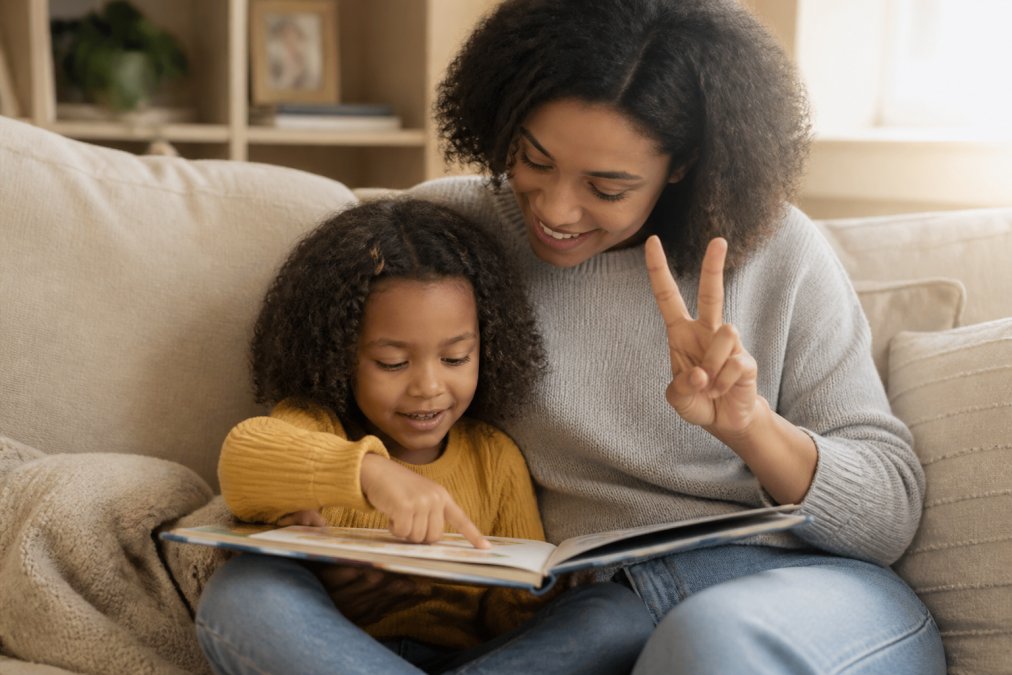
Here's how to use the 5 Finger Rule without turning it into a test:
- Pick a page from the middle of the book, not the first page.
- Have your child read it aloud at their normal pace.
- Count only words they stumble on and can't self-correct.
- Count missed comprehension, too. A word read perfectly but not understood still counts.
- Re-test every few months. Reading levels move faster than you expect.
Best Books for 5 Year Olds: What to Look For
The best books for 5 year olds sit in a narrow but rewarding zone: a story simple enough to follow in one sitting, with enough repetition that your child starts "reading" along from memory. That memorized reading is real literacy work, it's how a child learns that print is stable and that their voice can carry a story.
At 5, most children are either pre-readers who know some letters and sounds or emergent readers who can decode simple CVC words (cat, sun, hop). The markers below help you choose for whichever place your child is in.
Look for these markers:
Visit & Subscribe on YouTube →
- A clear problem and resolution inside 32 pages. Problem by page 8, complication by page 20, resolution by page 28. If you can't find the problem by page 10, the book is probably too abstract for this age.
- Rhyme, refrain, or a repeated phrase your child can join in on. This is the single strongest predictor of a 5-year-old's engagement. Chicka Chicka Boom Boom (Bill Martin Jr.) and Room on the Broom (Julia Donaldson) are built entirely on this mechanism.
- Illustrations that show what the text says rather than contradict it. At 5, a child uses pictures to decode unfamiliar words. If the art shows a rabbit but the text says "hare," you've added a puzzle, not a clue.
- Characters who make a choice, so you can talk about it afterward. The Rainbow Fish (Marcus Pfister) and Enemy Pie (Derek Munson) both hinge on a decision a child can evaluate.
- A vocabulary stretch of one or two words per page. Not zero (boring) and not five (frustrating). Words like "enormous," "scampered," or "delighted" are the right stretch for most 5-year-olds.
Skip these:
- Dense paragraphs of more than three sentences on a page
- Abstract themes (death, war, complex emotions) without a concrete story to carry them
- Books with no clear protagonist, a 5-year-old needs someone to root for
- TV or movie tie-in books that assume you've seen the show. They often skip the story setup entirely.
A 60-second in-store test:
- Open to a random middle page and read it aloud yourself. If you stumble, the book is too complex.
- Count the words on that page. More than 60 is likely too dense for a 5-year-old's attention span.
- Look for a repeated line. If you find one, your child will be "reading" it with you by the third night.
- Check the ending. A satisfying resolution, even a silly one, is what makes a 5-year-old ask for the book again.
If your child is already decoding simple words, add one early reader to the stack each week alongside the picture books. Elephant & Piggie (Mo Willems) and the Pete the Cat early readers are the most reliable entry points: the sentences are short, the humor lands, and the pictures do half the decoding work.
Matching Books to Your Child's Interests and Personality
Interest-based selection beats reading-level charts every time. A child who loves dogs will push through a harder dog book than an easy book about something they don't care about.
Watch what your child already does. Do they narrate elaborate stories with toys? Try picture books with rich plots. Do they ask how things work? Nonfiction with photographs. Do they want the same book nightly? That repetition is comfort, and it builds fluency.
Child-led selection also matters at the library. Let them pick one book freely for every two you choose, and their engagement with the whole stack goes up.
Beyond the Basics: Neurodivergent Readers, Digital Formats, and Sensitive Topics
Most book lists stop at age charts. Three gaps matter just as much for real families.
Neurodivergent readers. Some children need shorter sentences, predictable structure, or high-interest topics well below their age level. A 7-year-old reading a book written for 5-year-olds isn't behind; they're building fluency on a ramp that works. For children with dyslexia or ADHD, decodable text and low-distraction page layouts help more than grade-level labels. The International Dyslexia Association's fact sheets covers structured literacy approaches.
Digital versus print. E-books offer adjustable text size, instant dictionary lookups, and audio narration, which helps struggling readers. Print still wins for print awareness, shared attention, and fewer distractions. Many families use both: print for bedtime, digital for travel.
Sensitive topics. Grief, divorce, moving, and fear show up in children's literature for good reason. Preview the book first, read it together rather than sending it to their room, and leave room for questions afterward.
Library strategies. Ask the children's librarian for level-appropriate picks, join a summer reading program, and use hold requests so you're not hunting shelves with a tired kid.
For families who want a series to grow with, Smokey D Baby Dogga offers ten adventure-themed storybooks built around friendship, kindness, and courage, with characters like Rocky the Ghost Dog and Bella the Bat. The Smokey D Baby Dogga coloring book and the bookmark are also available.


Choosing books for a child who reads at grade level, one who's still sounding out words, and one who only wants dog stories is genuinely hard, and no single chart solves it. Smokey D Baby Dogga builds stories around kindness, friendship, and adventure, with video trailers for book previews, ten distinct adventure-themed books, and official merchandise like mugs and tote bags. Visit and subscribe on YouTube to meet Smokey and her friends.
Frequently Asked Questions
What is the 5 finger rule for choosing books?
The 5 finger rule helps you check if a book is the right reading level for your child. Have your child read a page aloud. Each time they miss a word, they hold up one finger. If they reach five fingers before the page ends, the book is too hard for independent reading. You can still read it together as a read-aloud. This method builds comprehension and fluency without frustration.
What are the different age categories for children's books?
Children's book age categories guide typically breaks down as follows: board books for ages 0-3, picture books for ages 3-5, early readers for ages 5-7, and chapter books for ages 7-9. These categories consider developmental stages, text complexity, and narrative structure. For example, board books focus on sensory experience and print awareness, while chapter books introduce longer storylines and independent reading.
How do I know if a book is age-appropriate for my child?
Check the book's format, text complexity, and themes. For toddlers versus school-aged children, look at the number of words per page and illustration quality. Use the 5 finger rule to assess reading level. Also consider your child's interest and emotional maturity. A book that is age-appropriate in reading level might still be too advanced in content. Trust your judgment and preview books when possible.
What should I look for in books for toddlers versus school-aged children?
For toddlers (0-3), choose board books with sturdy pages, simple text, and bright illustrations that support phonemic awareness. For school-aged children (6-8), look for early readers and chapter books with more complex plots, diverse perspectives, and vocabulary acquisition opportunities. Both age groups benefit from read-aloud sessions. Smokey D Baby Dogga offers adventure-themed books, plus a bookmark.