
Character Merchandise That Sparks Imagination & Learning
Table of Contents
- Why Character Merchandise Beats Generic Toys for Imaginative Play
- The Benefits of Imaginative Play for Toddlers (and Big Kids Too)
- Where to Buy Educational Books for Kids Online (Without Guessing)
- Creative Gift Ideas for Young Readers: Books, Puzzles, and More
- Age-by-Age Guide: Matching Character Merchandise to Developmental Milestones
- Safety and Durability: What to Check Before You Buy
- Budget-Friendly DIY Character Play: Extending the Story Beyond the Book
- Frequently Asked Questions
Last Updated: September 22, 2026
Why Character Merchandise Beats Generic Toys for Imaginative Play
Character merchandise is any product built around a specific storybook figure or cast, books, puzzles, journals, apparel, and accessories that carry a recognizable character into daily play. It outperforms generic toys because the child already knows who the character is and how they behave.
The Benefits of Imaginative Play for Toddlers (and Big Kids Too)
The benefits of imaginative play for toddlers extend well past preschool: imaginative play supports cognitive development, language, self-expression, and problem-solving from age three through the early school years.
How Storytelling and Role-Playing Build Cognitive Skills
Storytelling forces a child to hold a sequence in their head, first the map, then the island, then the treasure. That sequencing is the same machinery behind reading comprehension and retention of information.
Social-Emotional Growth Through Character-Based Play
Social-emotional growth is the quiet payoff of character-based play. Children who act out friendship, teamwork, and conflict resolution with familiar characters carry those scripts into real interactions.
- Your child assigns different characters to different friends and negotiates who plays whom
- They invent problems for the characters to solve, then solve them
- They bring up a character's choice later, out of context ("Smokey shared, so I did too")
- They replay a scary or sad scene repeatedly to process it
Where to Buy Educational Books for Kids Online (Without Guessing)
Buying educational books for kids online comes down to three checks: a stated age range, a preview you can watch or read, and a clear look at the art style before you pay. Skip any listing that offers none of the three, most show only a cover, a price, and marketing copy.
A practical buying checklist:
- Does the listing state an age range?
- Can you preview the art or read a sample page?
- Is the cast of characters consistent across titles?
- Are there companion products that extend the same world?
- Is the price listed clearly with no subscription attached?
Creative Gift Ideas for Young Readers: Books, Puzzles, and More
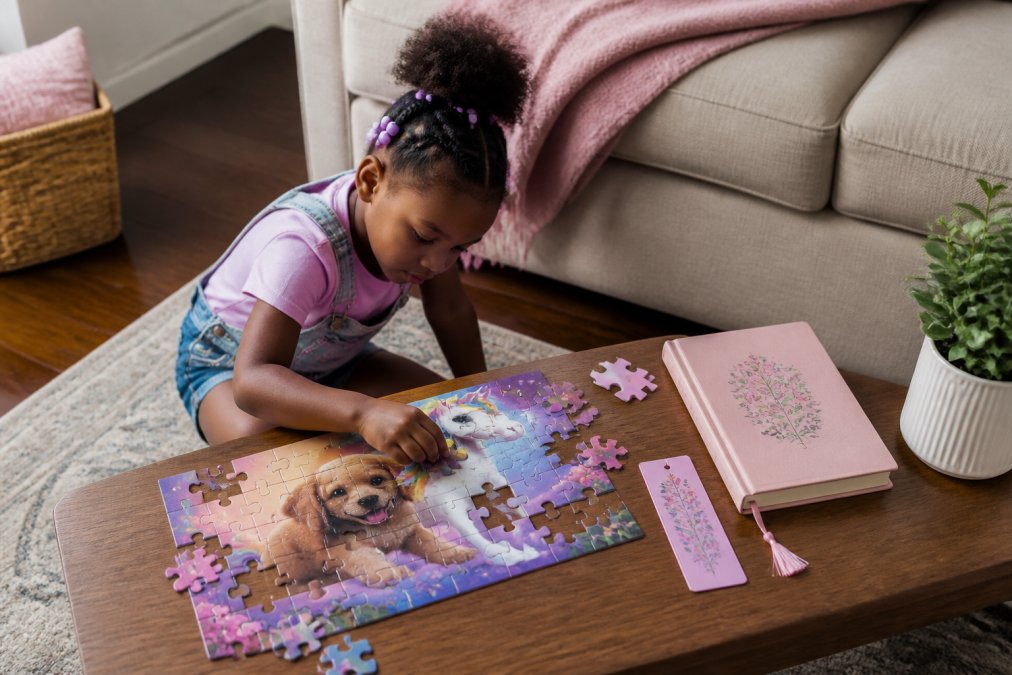
The best creative gift ideas for young readers pair a story with something the child can do with their hands. A book alone is a gift for one evening; a book plus a puzzle, journal, or coloring book keeps the story alive for months.
Puzzle Power: Building Spatial Reasoning Piece by Piece
Spatial reasoning is the ability to mentally rotate, fit, and track shapes, and jigsaw puzzles build it directly. A child who learns a corner piece goes in a corner is doing geometry without knowing it.
Age-by-Age Guide: Matching Character Merchandise to Developmental Milestones
Matching character merchandise to developmental milestones is less about a birthday and more about attention span, fine-motor control, and the kind of thinking a child is ready to do. The table below is a starting point; the archetype mapping underneath determines whether a character toy teaches anything.
| Age | Typical Attention Span | Best Character Merchandise | What It Builds |
|---|---|---|---|
| 3-4 | 5-10 minutes | 110-piece puzzle, coloring book | Fine motor control, color naming, single-word narration |
| 4-5 | 10-15 minutes | Picture books, bookmark | Story sequencing, print awareness, turn-taking |
| 5-6 | 15-25 minutes | 252-piece puzzle, journal | Spatial reasoning, early writing, perspective-taking |
| 6-8 | 25-45 minutes | 520 or 1014-piece puzzle, chapter reading | Problem-solving, persistence, multi-scene plotting |
Mapping Character Archetypes to Learning Outcomes
Most guides skip this: the character a child plays with is not interchangeable, the archetype shapes which skill gets rehearsed.
Smokey D Baby Dogga and Friends Kids →
- The brave explorer (a puppy setting out on a voyage, a chipmunk crossing a forest) rehearses spatial reasoning and sequencing. The child has to track where the character is, where they came from, and what comes next. Pair with map-drawing, puzzles, and any story where the destination is unknown.
- The loyal friend (a sidekick who stays when things get hard) rehearses empathy and conflict resolution. The child practices reading another character's feelings and choosing a response. Pair with role-play where two kids must agree on who plays whom.
- The trickster or ghost (a mischievous ghost dog, a bat who hides) rehearses flexible thinking and humor. The child learns that rules can bend and that surprise is safe. Pair with story-swap games, 'what if the ghost dog did the opposite?'
- The caregiver (a character who tends to a lost animal) rehearses self-regulation and nurturing. The child practices patience and gentle handling. Pair with journaling and drawing prompts about how the character felt.
How the Play Itself Evolves
Character-based imaginative play doesn't just get longer as kids age; it changes shape. The rough arc most parents observe:
- Toddler (2-3): The child holds the character and makes it do one action, jump, sleep, eat. The story is a single beat.
- Preschool (3-5): The child strings two or three beats together and narrates them out loud. 'Smokey is scared, then she is brave, then she finds the acorn.'
- Early school (5-7): The child invents a problem and a solution, and assigns roles to siblings or friends. Negotiation enters the play.
- School age (7-9): The child builds multi-scene plots, rewrites endings, and moves between the character's perspective and their own. This is where journaling and original story-writing take over from pure play.
Safety and Durability: What to Check Before You Buy
Safety and durability checks for character merchandise take about two minutes and prevent most problems parents run into later. But character toys face wear generic toys do not: they get carried, narrated to, slept with, and replayed for months.
The Two-Minute Safety Check
- Choking hazards: Anything small enough to fit through a toilet paper tube is a risk for kids under three. For puzzles, that means checking piece size against the stated age range, not just the box label.
- Print quality: Cheap inks fade or smear, and peeling laminate means exposed edges that flake. Run a thumb across a printed surface, if color transfers, it will transfer to a child's mouth.
- Storage: A sturdy box keeps pieces together and makes the product last years instead of months. Flimsy boxes are the number-one reason puzzles end up in a bag of loose pieces.
- Age labeling: If the manufacturer states a range, believe it. The label reflects testing, not marketing.
- Non-toxic claims: Look for a clear statement that inks and coatings are non-toxic. If the listing is silent, treat that as a gap.
Durability Under Real Play
Durability is where character merchandise earns or loses its place. Wear patterns are predictable:
- Puzzle pieces get bent at corners, chewed at edges, and separated from their box. A 100% chipboard puzzle with a glossy laminated face resists smudges from sticky fingers and holds up to repeated assembly. A dry microfiber cloth handles cleanup without lifting the print.
- Books get dropped, bent, and read at the table. A hardcover binding survives a toddler's grip far better than a paperback, and it lays flat for shared reading.
- Journals and coloring books get used hard. A sewn or glued spine that stays flat matters more than cover art.
- Bookmarks and small accessories are the first things lost. A laminated bookmark survives a backpack; a paper one does not.
The Cost-Per-Use Test
Durability is also a budget question. Divide the price by the play sessions you realistically expect: a $27.99 puzzle used twice a week for a year is a few cents per session, while a $9 puzzle that falls apart in a month is more expensive per use.
Budget-Friendly DIY Character Play: Extending the Story Beyond the Book
DIY character play costs almost nothing and often produces the deepest engagement, because the child builds the world rather than consuming it. After reading Pirate Treasure Ship, hand your child paper and ask them to draw their own treasure map, the story gives them the rules, the blank page gives them freedom.
- Character voices: Assign each family member a character and read the book aloud in parts
- Living room theater: Blankets become the magical forest, the couch becomes the ship
- Recipe tie-ins: After the cooking adventure, bake something together and name it after a character
- Story swaps: Ask your child to retell the ending. What if Charlie never found the acorn?
- Drawing prompts: One coloring page a day, then hang the finished art at kid height
Frequently Asked Questions
What are the best types of character merchandise for imaginative play?
Storybooks, puzzles, coloring books, and journals that feature recognizable characters give kids a springboard for pretend play. A 110-piece puzzle builds spatial reasoning, while a 24-page coloring book lets a child reimagine scenes from a favorite story. Character merchandise works best when it invites open-ended play rather than scripting every move. Look for items that connect to a narrative your child already loves, so they can extend the story on their own terms.
How does character-based play support cognitive development in children?
When kids act out stories with familiar characters, they practice sequencing events, predicting outcomes, and holding multiple ideas in mind at once. This is the same mental muscle used for reading comprehension and problem-solving. Research on play-based learning consistently links pretend play to stronger language skills and creative thinking. Character merchandise gives children concrete anchors, like a plush friend or a puzzle scene, that make abstract story concepts easier to grasp and replay.
What should parents look for when buying educational character-themed gifts?
Check three things: age range, materials, and whether the item invites more than one type of play. A puzzle with 110 to 1014 piece options grows with your child. A hardcover journal supports writing and drawing. A bookmark encourages reading independence. Avoid items that only do one thing. The best character gifts combine a familiar face with an activity that stretches a skill, whether that is fine motor control, storytelling, or empathy.
How can story-driven merchandise help children develop social-emotional skills?
Stories about friendship, courage, and kindness give children a vocabulary for their own feelings. When a character faces a problem and works through it with friends, kids practice perspective-taking. Pairing that story with a related product, like a coloring book or journal, lets them process those emotions through art or writing. Over time, this builds empathy and self-expression. The key is choosing characters whose values you want your child to absorb.
What are the benefits of combining books with character-themed products?
Books alone spark imagination, but adding a puzzle, journal, or bookmark turns a single story into an ongoing world. A child who reads about a magical forest can then color it, write their own adventure in a journal, or rebuild a scene as a puzzle. This repetition deepens retention of information and keeps curiosity alive. It also gives siblings of different ages a shared activity, since a 3-year-old and a 7-year-old can enjoy the same characters at different levels.