
Best Books to Encourage Imagination for 6 Year Olds
Table of Contents
- Quick Comparison: Imagination Books for 6 Year Olds
- How We Evaluated These Imagination Books
- Picture Books That Spark Creative Thinking
- How to Encourage Creative Thinking in 6 Year Olds
- Educational Storybooks with Video Trailers
- Imaginative Play Ideas Based on Children's Books
- Imagination Type Quiz: Matching Books to Your Child
- Conclusion
- Frequently Asked Questions
Last Updated: September 16, 2026
Quick Comparison: Imagination Books for 6 Year Olds
Finding the best books to encourage imagination for 6 year olds comes down to one question: does the story leave room for your child to add something of their own? A book that answers every question for them entertains for ten minutes. A book that leaves a door open fuels play for weeks.
| Title | Imagination Type | Price | Best For |
|---|---|---|---|
| Smokey D Baby Dogga: Magical Forest | Fantasy and world-building | $14.99 | Kids who invent hidden places |
| Smokey D Baby Dogga: Moon Mission | Exploration and curiosity | $14.99 | Space-obsessed kids |
| Smokey D Baby Dogga: Pirate Treasure Ship | Adventure and problem-solving | $14.99 | Action-first readers |
| Smokey D Baby Dogga and the Golden Acorn Adventure | Empathy and teamwork | $14.99 | Kids who love animal friends |
| Smokey D Baby Dogga: Amazing Trip Around the World | Cultural curiosity | $14.99 | Kids who ask "where is that?" |
| Smokey D Baby Dogga Coloring Book | Creative expression | $12.95 | Kids who want to draw the story |
| Smokey D Baby Dogga and Friends Jigsaw Puzzle | Hands-on storytelling | $27.99 | Puzzle lovers, ages 3-8 |
How We Evaluated These Imagination Books
Most book lists rank titles by popularity or by how pretty the cover is. That tells you nothing about whether a story will actually leave your six-year-old inventing after the last page. So we scored every title against five criteria, each rated 1-5, for a total out of 25.

| Criterion | What It Measures | Why It Matters at Age Six |
|---|---|---|
| Open-endedness | Does the story leave gaps a child can fill? | The single strongest predictor of post-reading play |
| Language richness | Vocabulary variety and rhythm of the read-aloud text | Six-year-olds add roughly 2,000-3,000 new words a year, and read-alouds are a primary source |
| Visual storytelling | Do the illustrations carry information the words don't? | At this age, kids read pictures as fluently as text |
| Play invitation | Does the story suggest something to build, draw, or act out? | Bridges the gap between reading and physical play |
| Re-readability | Does the child want it again tomorrow? | Imagination compounds on repetition, not novelty |
How to Read the Scores
A title scoring 20-25 is a strong imagination pick you can return to for years. A 15-19 is solid but may need you to prompt the play. Below 15, the story tends to do all the imagining for the child. Use the scores as a starting filter, then match to your child's imagination type using the quiz further down.
The Trade-Off Nobody Mentions
Open-ended stories can frustrate a child who wants a clear ending, and tightly plotted stories can bore a child who wants to invent. Neither is wrong. The fix is to keep two or three books of each type on the shelf and let your child choose by mood, not by what the list says is "best."
Picture Books That Spark Creative Thinking
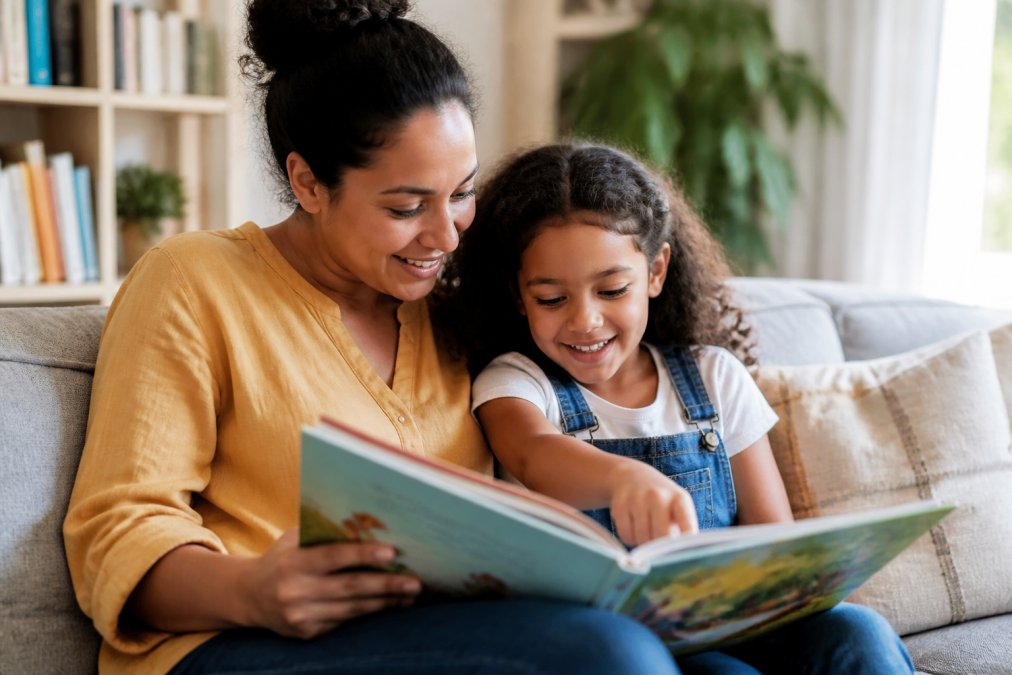
Picture books do the heaviest lifting for imagination at age six, because the illustrations carry half the storytelling. When art leaves details unexplained, kids supply them.
Fantasy and Adventure Picks
Fantasy gives a six-year-old permission to break rules they follow all day. The trick is choosing fantasy with structure, so the imaginary world has logic your child can extend.
Everyday Wonder and Discovery
Not every imaginative child wants dragons. Some want to know how the world works, and that curiosity is its own kind of creativity.
How to Encourage Creative Thinking in 6 Year Olds
The most effective way to encourage creative thinking in 6 year olds is to stop the story before it ends and ask what happens next. Reading is passive by default. A single well-placed question converts it into active imagining.
Before You Read: Set the Frame
- "Look at the cover. What do you think is about to happen?"
- "If you could step into this picture, where would you go first?"
- "What do you think the main character wants more than anything?"
During the Read: Pause at the Problem
- "What would you do here?", ask this before turning the page, not after.
- "What if the character made the opposite choice?"
- "Who else could help them right now?"
- "What does that character's face tell you that the words don't?"
After the Read: Extend the World
- "What happens the very next morning?"
- "Draw the scene the book skipped."
- "If you wrote the sequel, what would the title be?"
- "Which character would you invite to dinner, and what would you serve?"
The Mechanism Behind the Questions
Six-year-olds are in what researchers call the "why" stage, they are building cause-and-effect models of the world. A question that forces them to predict, reverse, or extend a story exercises the same mental muscle they use to figure out why the sky is blue or why a friend is upset. The story is just a safe rehearsal space.
Bridge to Physical Play
Questions work best when they lead somewhere your child can move. After the prompts above, hand over the story:
Smokey D Baby Dogga Coloring Book – 24 →
- Space stories: Build a "moon crater" with a baking sheet and flour, then let your child land a toy on it.
- Treasure stories: Hide three clues around the house on paper scraps and let your child follow the map.
- Cooking stories: Set out bowls, spoons, and pretend ingredients, then "bake" alongside the characters.
Educational Storybooks with Video Trailers
Educational storybooks with video trailers solve a specific problem: previewing a book before you buy it. A trailer shows the art style, the tone, and the characters in under two minutes, which tells you more than a product description ever will.
Imaginative Play Ideas Based on Children's Books
Imaginative play ideas based on children's books work because the story supplies the setup and your child supplies the action. You are not buying new toys. You are extending a world that already exists in their head.
- Space stories: Build a "moon crater" with a baking sheet and flour, then let your child land a toy on it. Moon Mission gives the script.
- Treasure stories: Hide three clues around the house on paper scraps. Pirate Treasure Ship supplies the premise.
- Cooking stories: Set out bowls, spoons, and pretend ingredients, then "bake" alongside the characters from Cooking Adventure.
Imagination Type Quiz: Matching Books to Your Child
Most book lists ignore a simple fact: two six-year-olds can have completely different imaginations. Match the book to the type, and the same story lands twice as hard.

Use this quick guide:
- The World-Builder invents places and maps them. Choose Magical Forest.
- The Explorer asks "what's out there?" Choose Moon Mission or Amazing Trip Around the World.
- The Adventurer wants action and stakes. Choose Pirate Treasure Ship.
- The Helper cares about characters and feelings. Choose Golden Acorn Adventure.
- The Maker wants to draw, build, or bake. Choose the coloring book or Cooking Adventure.
Conclusion
The gap between a child who reads and a child who imagines is usually one question, asked at the right moment. Six-year-olds are ready for that nudge, and the right story gives you the opening.

Frequently Asked Questions
How do books help develop a child's imagination?
Books give 6-year-olds a safe space to picture places and characters they have never seen. When a story describes a magical forest or a moon mission, your child builds that world in their head, which strengthens creative thinking and problem-solving. Picture books with rich illustrations add visual storytelling that anchors those mental images. The more often children practice this mental world-building during read-aloud time, the more flexible their thinking becomes in everyday play and learning.
Are picture books still good for 6-year-olds?
Yes. Six-year-olds are often moving into early readers, but picture books still deliver huge value. The combination of illustrations and text supports reading comprehension, vocabulary growth, and narrative development. Picture books also tend to introduce richer language than simple leveled readers, which helps with language acquisition. Choose titles with layered stories and detailed art so your child can revisit them and notice something new each time, keeping engagement high.
What makes a book imaginative for early elementary students?
An imaginative book for early elementary students usually has three things: a world that follows its own rules, characters who face open-ended problems, and illustrations that leave room for wonder. Stories about magical forests, space travel, or pirate treasure invite children to ask 'what if.' Books that pose a problem without an obvious answer encourage critical thinking and creative expression. Look for titles that mix fantasy or adventure with relatable emotions so your child can connect the story to their own life.
How can I make reading more interactive for my 6-year-old?
Try pausing mid-story to ask open questions like 'What would you do here?' or 'What do you think happens next?' Let your child act out a scene, draw a character, or build a small world from blocks based on the book. Pairing a story with a hands-on activity, such as a coloring page or a puzzle featuring the same characters, turns reading into imaginative play. These small moves boost engagement and help your child remember the story long after you close the book.
What are the best themes for 6-year-old readers to spark creativity?
Themes that work well for 6-year-olds include fantasy and adventure, animal friendships, exploration of new places, and everyday discovery. Stories about kindness, courage, and teamwork give children emotional hooks while still leaving room for imagination. Books set in magical forests, outer space, or around the world introduce new ideas without overwhelming young readers. Mixing classic tales with modern adventures keeps storytime fresh and helps your child build a wide range of creative thinking skills over time.