
Educational Storybooks with Video Trailers: 2026 Guide
Table of Contents
- Why Educational Storybooks with Video Trailers Work for Young Readers
- Benefits of Book Trailers in Education
- Book Trailer Examples for Students: What Great Ones Include
- Smokey D Baby Dogga: Educational Storybooks with Video Trailers for Kids 3-8
- How to Make a Book Trailer for School Projects
- How to Use Book Trailers in the Classroom
- Building a Home Reading Routine Around Video Previews
- Conclusion
Last Updated: August 16, 2026
Young readers today are growing up in a visual world, and the gap between a child who loves books and one who resists them often comes down to a single question: does the story feel alive before they even open the cover? Educational storybooks with video trailers answer that question directly. At Smokey D Baby Dogga, we've built an entire series of adventure-driven children's books around this idea: give kids a sneak peek into the world of the story, and they'll come back for more. Below, this guide covers what makes book trailers work pedagogically, what great ones actually include, and how to use them at home and in the classroom.

Why Educational Storybooks with Video Trailers Work for Young Readers
Educational storybooks with video trailers work because they activate two learning channels at once: visual storytelling and narrative engagement. Before a child reads a single sentence, a well-made trailer has already introduced the characters, set the emotional tone, and created a reason to care about what happens next.
Visual Storytelling and Story Comprehension
Visual cues are among the most effective tools for building story comprehension in early readers. When children watch animated storytelling that mirrors the book's narrative arc, they develop a mental map of the story before encountering the text. This pre-reading scaffold supports vocabulary acquisition, sequencing skills, and emotional prediction, all foundational to literacy development.
According to the American Academy of Pediatrics' guidance on media and early literacy, multimedia learning is most effective when digital content is paired with adult interaction and connected to print materials. Book trailers become an educational bridge rather than a screen-time substitute. The result is a child who approaches the book with confidence, already knowing the character and wanting to discover how the adventure ends.
Reading Motivation Across Age Groups
Reading motivation is one of the strongest predictors of long-term literacy outcomes. A child who reads at grade level but finds books boring is at just as much risk of falling behind as one who struggles with decoding.
Book trailers address motivation directly. For children aged 3 to 5, the appeal is sensory: bright colors, friendly characters, and music that signals "this is fun." For children aged 6 to 8, the hook shifts toward narrative curiosity. A trailer that ends on a cliffhanger gives older early readers a genuine reason to pick up the book. Anticipation is the engine of reading motivation.
Benefits of Book Trailers in Education
Book trailers offer educators a practical way to build student engagement around new titles. The pedagogical value goes beyond simple book promotion: trailers introduce literary vocabulary, model narrative structure, and create shared reference points that support classroom discussion.
Classroom Integration and Curriculum Alignment
Classroom integration of book trailers works best when tied to specific learning outcomes. A trailer can serve as a pre-reading activation activity, a vocabulary preview, or a discussion prompt for themes like friendship, courage, or problem-solving. These themes align naturally with social-emotional learning standards that many elementary curricula now include.
Book trailers also teach media literacy. Watching a trailer critically, asking what the creator wants you to feel, what details were chosen, and what was left out, teaches children to analyze digital content rather than simply consume it. This skill is identified as essential by the International Society for Technology in Education's framework for digital literacy.
Accessibility Features That Support All Learners
Accessibility features in book trailers matter enormously for inclusive classrooms. Trailers that include closed captions support children with hearing differences and English language learners. High-contrast visuals and clear animation support children with visual processing differences.
When evaluating trailers for classroom use, check for closed captions, clear animation without rapid scene changes, narration paced slowly enough for young listeners, and distinct character voices. These features improve comprehension for every child in the room.
Book Trailer Examples for Students: What Great Ones Include
The strongest book trailer examples for students share a recognizable structure. A great trailer runs between 60 and 90 seconds, introduces one or two central characters, establishes a problem or question, and ends before the resolution.
| Element | Why It Matters | What to Look For |
|---|---|---|
| Character introduction | Builds emotional connection fast | Named character, clear personality trait |
| Narrative question | Creates reading motivation | Problem posed, not answered |
| Visual style match | Sets accurate expectations | Matches the book's actual illustrations |
| Pacing | Holds attention without overwhelming | Slow enough for 3-year-olds to follow |
| Closed captions | Supports all learners | Text synced to narration |
| Call to action | Drives book discovery | Clear "read the book" prompt |
Technical Criteria That Make a Trailer Worth Watching
Technical quality in a book trailer is about clarity, not budget. A trailer shot on a smartphone with good lighting and clear audio will outperform an expensive production that's too fast, too loud, or too visually complex.
For educators evaluating trailers, key technical criteria are: clear narration free of background noise, crisp images on a classroom projector, 60 to 90 seconds in length, and accessibility on YouTube or without requiring additional logins.
Smokey D Baby Dogga: Educational Storybooks with Video Trailers for Kids 3-8
Smokey D Baby Dogga offers educational storybooks with video trailers that genuinely hold a child's attention. The series offers ten distinct adventure-themed books, each paired with video trailers available on YouTube.

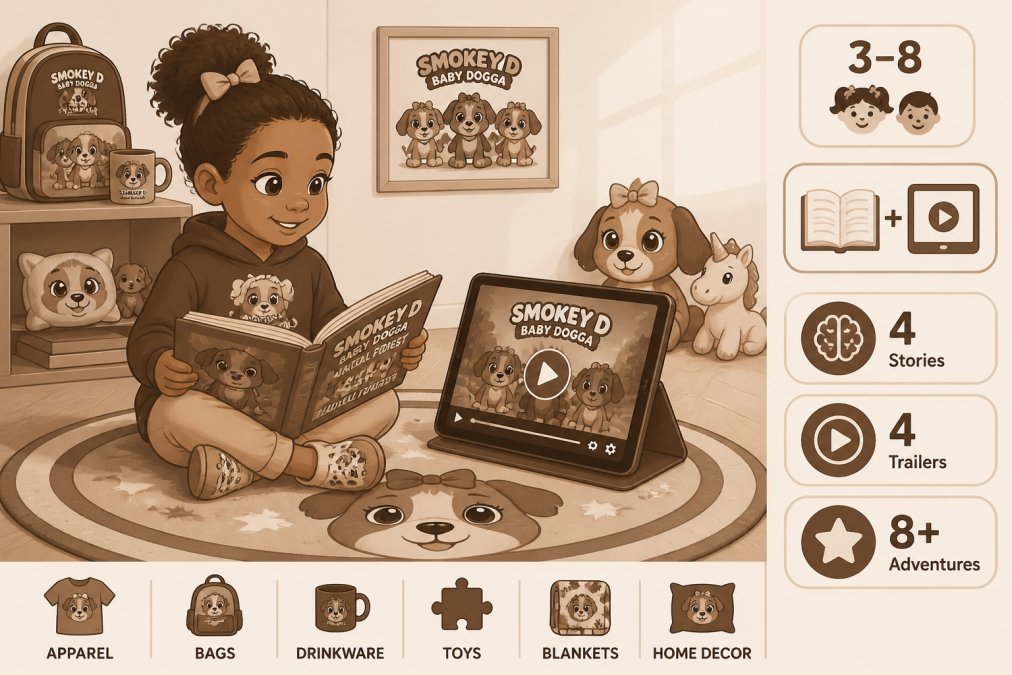
What separates Smokey D Baby Dogga from other children's book series is the specificity of its character world. Each book features a cast of recurring friends, which means children build genuine familiarity and affection across titles rather than starting over with strangers every time they pick up a new book.
The Characters and Adventure Themes
The Smokey D Baby Dogga universe centers on Smokey and her friends, including Rocky the Ghost Dog and Bella the Bat. Rocky's ghostly nature opens conversations about imagination; Bella's bat identity lets the stories explore nocturnal adventure and difference without making either feel threatening.
The ten adventure themes range from magical forests and moon travel to fishing trips, camping, and a visit to a chocolate factory. This variety serves the 3-to-8 age range deliberately. A 3-year-old gravitates toward the sensory richness of the camping and chocolate factory stories. A 7-year-old finds action and stakes in the moon adventure and magical forest titles. The themes carry consistent values: friendship, kindness, courage, and discovery, which makes the books easy to connect to social-emotional learning discussions.
Extend the Story Beyond the Book
The brand extends the story into the child's everyday environment through merchandise that keeps the characters present between reading sessions. The Smokey D Baby Dogga Coloring Book ($12.95) features 24 original pages, letting children re-enter the story through their own creative work. The Smokey D Baby Dogga and Friends Kids Jigsaw Puzzle ($27.99) is available in four piece counts from 110 to 1,014, scaling with the child's age. The Smokey D Baby Dogga & Friends Bookmark ($11.99) turns finding your place in a book into a moment of delight.
These tools keep the story alive between sessions, which reading motivation research says matters most.
How to Make a Book Trailer for School Projects
Making a book trailer for a school project is one of the most effective ways to deepen a student's comprehension of a text. The process requires them to identify the narrative arc, choose which details communicate character and conflict, and make editorial decisions about what to include and leave out.
Visit & Subscribe on YouTube →
Planning the Narrative Arc
The narrative arc is the backbone of any effective trailer. Before students touch any recording equipment, they should answer three questions in writing:
- Who is the main character, and what do we know about them in the first act?
- What problem or question drives the story?
- What moment in the book creates the strongest emotional hook without giving away the ending?
These three answers become the structure of the trailer: introduce, complicate, leave unresolved. According to the National Council of Teachers of English's framework for 21st-century literacies, student-created digital media projects develop critical thinking, communication, and creative skills simultaneously.
Free Tools and Simple Production Steps
Making a book trailer for school projects doesn't require expensive software. The following workflow uses tools available on most school devices:
- Script: Write a 60-to-90-second narration script and time it before recording.
- Visuals: Use drawings, scanned illustrations, or photographs related to the story.
- Recording: Use built-in microphones in a quiet space.
- Editing: Free tools like iMovie, Clipchamp, or browser-based video editors allow students to combine images, narration, and music.
- Music: Use royalty-free music from free libraries.
- Export: Export at standard resolution and upload to a classroom-approved platform.
The entire process typically takes two to three class sessions with a clear planning framework.
How to Use Book Trailers in the Classroom
Book trailers are most effective in the classroom when they serve a specific instructional purpose rather than functioning as entertainment filler.
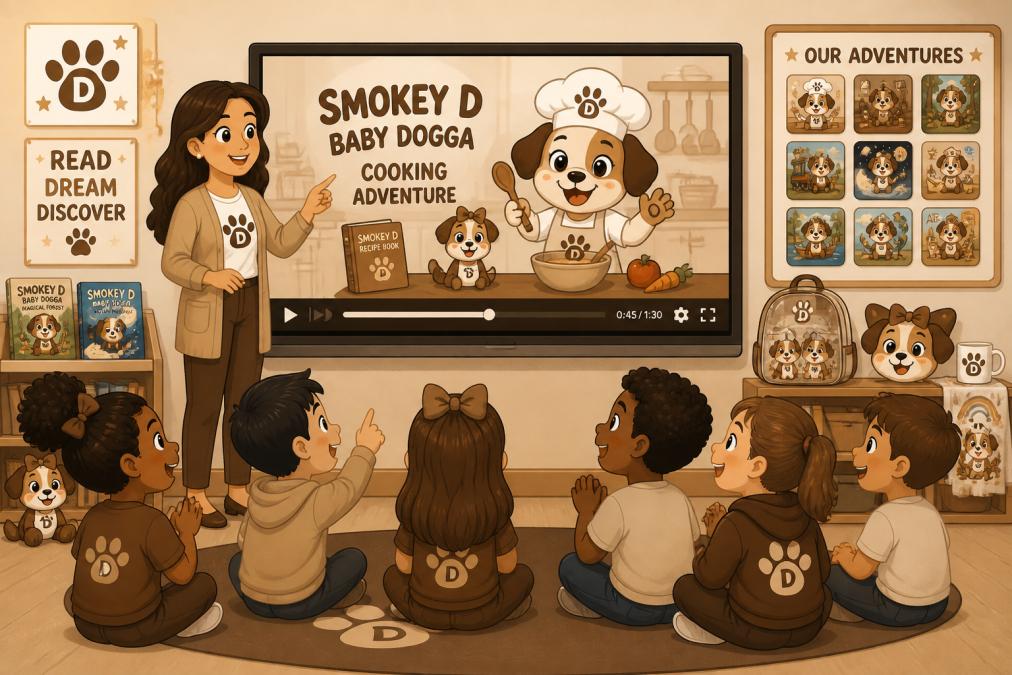
Before reading: Show the trailer as a pre-reading activation. Pause after the character introduction and ask students to predict what problem the character will face.
During a read-aloud unit: Use the trailer at the start of each week to re-engage students with the story's characters and themes.
After reading: Show the trailer again and ask: what did the trailer get right? What did it leave out? This post-reading discussion develops critical media literacy and reinforces comprehension.
For book selection: Let students watch trailers for three or four titles and vote on which book the class reads next. This gives children genuine agency in the reading process, which research consistently links to stronger reading motivation.
A practical classroom schedule might look like this:
| Day | Activity | Duration |
|---|---|---|
| Monday | Watch trailer, predict story | 10 minutes |
| Tuesday-Thursday | Read aloud, discussion | 20 minutes/day |
| Friday | Re-watch trailer, compare to book | 15 minutes |
Building a Home Reading Routine Around Video Previews
The biggest mistake parents make with book trailers is treating them as a one-time event. Build the trailer into a repeatable home routine. A short trailer at the start of reading time signals to a child that something interesting is about to happen.
For children aged 3 to 5, the same trailer can be watched multiple times across a week without losing its effect. Repetition is how language acquisition works.
For children aged 6 to 8, the trailer works better as a discovery tool. Let the child choose which trailer to watch from a curated collection, then follow their choice with the corresponding book. This positions the child as an active participant in building their reading life.
The Smokey D Baby Dogga YouTube channel gives families a ready-made library of trailers to use this way. Subscribe and let children browse available previews as part of their weekly reading selection. Pairing the viewing habit with physical reading companions, like the Smokey D Baby Dogga Sticker Sheet ($10.99) used as a reading reward, or the Smokey D Baby Dogga and Friends Decorative Pillow ($30.99) as a dedicated reading-nook anchor, turns the routine into an environment children want to return to.

The goal is a reading life that feels inhabited, not assigned.
Building a reading habit in children aged 3 to 8 is genuinely hard when books have to compete with every other form of digital content available to them. Educational storybooks with video trailers close that gap by meeting children in the visual medium they already respond to, then drawing them toward the deeper experience of the book itself. Smokey D Baby Dogga offers ten adventure-themed titles, each with a YouTube trailer and a cast of memorable characters including Rocky the Ghost Dog and Bella the Bat, designed specifically for this age range. Visit and subscribe to the Smokey D Baby Dogga YouTube channel to start building your child's preview library today.
Frequently Asked Questions
How do video trailers help children engage with educational books?
A short video trailer gives children a sneak peek at the characters, setting, and story before they open the first page. That preview builds anticipation and activates prior knowledge, which supports story comprehension once reading begins. For reluctant readers aged 3-8, seeing a narrative arc play out in 60-90 seconds through animated storytelling and music creates an emotional hook that a cover image alone rarely achieves. Educational storybooks that pair trailers with the text tend to see stronger reading motivation because the child already feels invested in the outcome.
Can video trailers improve reading comprehension in elementary students?
Research on multimedia learning consistently shows that combining visual cues with text strengthens recall and story comprehension, particularly for early childhood learners. A book trailer introduces vocabulary, character names, and plot structure before the child encounters them on the page, reducing cognitive load during reading. Teachers who use trailers as a pre-reading activity report stronger discussion participation and better retelling of events. The key is pairing the trailer with guided questions so students connect what they saw to what they read, turning passive viewing into an active learning outcome.
Do video trailers for books count as screen time?
Technically yes, a book trailer plays on a screen. However, the American Academy of Pediatrics distinguishes between passive consumption and purposeful, educational media use. A 60-90 second trailer watched together with a caregiver, followed immediately by reading the physical book, fits the AAP's co-viewing guidance for children aged 2 and up. The goal is for the trailer to serve as a bridge to the printed page, not a replacement for it. Keeping trailer viewing short and pairing it with hands-on reading keeps total screen exposure well within recommended daily limits.
Where can I find educational storybooks that feature multimedia components like video trailers?
The Smokey D Baby Dogga series offers video trailers on its official YouTube channel for each of its ten adventure-themed books, covering themes like friendship, courage, and discovery for children aged 3-8. Beyond that, many independent children's publishers post trailers on YouTube or embed them on their own websites. Searching a book's title plus 'book trailer' on YouTube is the fastest method. School librarians often maintain curated collections of trailer links alongside their classroom resources, making them a practical first stop for teachers seeking digital literacy tools.
What should I look for when evaluating a book trailer for young children?
Start with age-appropriate pacing, trailers aimed at children aged 3-8 should run 60-90 seconds with clear visuals and simple language. Look for captions or subtitles as an accessibility feature, especially for children with hearing differences or those learning to read. Strong trailers establish at least one character, hint at a conflict or adventure, and end without revealing the resolution, preserving the child's motivation to read. Audio quality matters too; muffled narration or jarring music can disengage young viewers before the story even begins.
This article was written using GrandRanker