
Benefits of Reading Moral Stories to Toddlers
Table of Contents
- Why Moral Stories Matter for Toddler Development
- How Reading Aloud to Toddlers Builds Language and Listening Skills
- How to Teach Toddlers Kindness Through Story Characters
- Short Moral Stories for Kids: The Right Length for Short Attention Spans
- Books That Teach Kindness to Kids: What to Look For
- Talking About a Story's Lesson Without Lecturing
- Building a Simple Read-Aloud Routine That Sticks
- Conclusion: Small Stories, Lasting Lessons
- Frequently Asked Questions
Last Updated: October 4, 2026
Why Moral Stories Matter for Toddler Development
Reading moral stories to toddlers is one of the simplest ways to shape how a young child understands kindness, honesty, and courage. At Smokey D Baby Dogga, we have spent years creating character-driven adventures for children ages 3 to 8, and we have seen how a well-told story stays with a child long after the book closes.

The toddler years are a key window for brain development. During this stage, a child's brain forms connections faster than at almost any other time of life. Stories feed that growth. They build language, spark imagination, and give children a safe way to explore right and wrong.
But here is what most guides get wrong. The value is not in the lesson itself. It is in how the lesson is delivered.
A toddler will not remember a rule you repeat. A toddler will remember a character who was scared and still chose to be brave. That difference matters, and it shapes everything below.
How Reading Aloud to Toddlers Builds Language and Listening Skills
Reading aloud to toddlers builds vocabulary, listening skills, and early literacy faster than almost any other daily habit. When you read aloud, your child hears new words in context, learns how sentences flow, and practices sitting still and paying attention.
The gains stack up over time:
- New words appear again and again, which helps them stick
- Rhyme and repetition make sounds easier to remember
- Questions during reading build comprehension
- Pointing at pictures links words to meaning
You do not need a big library. You need a routine. Ten minutes a day, most days, does more than an hour once a week. The American Academy of Pediatrics guidance on shared reading notes that reading together supports both language growth and parent-child bonding.
That bond is the quiet engine behind everything else. A child who feels close to you while reading is a child who listens.
How to Teach Toddlers Kindness Through Story Characters
The fastest way to teach toddlers kindness is to let them watch a character choose it. Children copy what they see, and a story character gives them something concrete to copy.
Take a moment like this: a character sees a friend who is sad and decides to share a snack. Your toddler sees the sad face, sees the kind act, and sees the friend smile. That chain is the lesson. No lecture needed.
A few ways to make this land:
- Pause on the character's face and name the feeling
- Ask, "What should she do next?"
- Point out the kind act when it happens
- Link it back to your child's own day
Our own books lean on this idea. In Smokey D Baby Dogga and the Golden Acorn Adventure, Charlie the Chipmunk loses something he loves, and his friends help him find it. The kindness is shown, not announced.
Short Moral Stories for Kids: The Right Length for Short Attention Spans
Short moral stories for kids work best at 5 to 10 minutes for toddlers, but the real variable is not the clock. It is how much story a toddler's working memory can hold at once. A 2-year-old can typically track one character, one feeling, and one action. A 4-year-old can hold a simple problem across several pages.
Here is how the same moral story changes shape across the toddler and preschool years:
| Age | Story Length | Vocabulary | Moral Complexity | What to Watch For |
|---|---|---|---|---|
| 18-24 months | 2-4 minutes | 1-2 new words per page; name objects and feelings | One feeling, one action ("she was sad, so she shared") | Pointing, labeling, and turning pages; the moral is absorbed, not discussed |
| 2-3 years | 3-5 minutes | Short sentences, concrete nouns, repeated refrains | A single kind-or-unkind choice with a visible result | Child predicts the next page or echoes a repeated line |
| 3-4 years | 5-8 minutes | Feeling words (proud, worried, sorry) and simple cause words (because, so) | A choice with a consequence the child can see | Child names a character's emotion without prompting |
| 4-5 years | 8-10 minutes | A few abstract words (fair, brave, patient) in context | Two characters with different needs, one resolution | Child offers a reason for a character's action |
| 5-6 years | 10-12 minutes | Richer description, some figurative language | A moral dilemma with a trade-off (tell the truth and get in trouble) | Child connects the story to a real event from their day |
A few practical rules follow from this table:
- Shorter is almost always safer. A 3-minute story read with warmth beats a 10-minute story read while your child squirms. Stop while interest is still high, not after it has drained.
- One new idea per reading. If a story introduces a new character, a new feeling, and a new setting all at once, a toddler will lose the thread. Introduce one and let repetition carry the rest.
- Repetition is the mechanism, not a fallback. Toddlers build memory through predictable patterns. A repeated refrain ("and then he shared again") lets a child anticipate, and anticipation is what keeps attention alive.
- Let the pictures carry half the story. A toddler reading a picture book is doing two jobs: listening and looking. If the illustrations are busy, shorten the text you read aloud.
The same series can serve more than one age. A 3-year-old follows the pictures and the feeling words while a 6-year-old follows the plot and the trade-off. That is one reason we built our adventures around a recurring cast of characters rather than a single story: familiarity lowers the cognitive load, so the child can spend attention on the moral instead of on figuring out who is who.
If you are unsure whether a story is the right length, try the two-page test. Read two pages aloud and watch your child's face. If they are still tracking the pictures and leaning in, continue. If their eyes drift to the room, the story is already too long for tonight, and that is fine. Shorten it, or pick a shorter one tomorrow.
Books That Teach Kindness to Kids: What to Look For
Books that teach kindness to kids share a few traits. The kind act is shown, not stated. The characters feel real.
Smokey D Baby Dogga and the Golden Acorn Adventure →
Start with the moral's framing. A toddler-friendly kindness story shows a choice and its visible result. A character sees someone sad, chooses to help, and the other character's face changes.
Then check for cultural inclusivity and relatability. A child who sees many kinds of families, bodies, abilities, and traditions in books learns early that kindness crosses every line.
- Varied family structures, single parents, grandparents, two moms or two dads, foster and adoptive families, extended kin. Toddlers notice who is in the pictures long before they can read the words.
- Varied skin tones, hair textures, and abilities, including characters who use wheelchairs, wear glasses, or sign. Representation should be ordinary, not a plot point.
- Settings beyond one neighborhood, rural, urban, coastal, and immigrant households, so the child's sense of "who counts" widens.
- Avoidance of stereotypes, watch for characters whose culture is treated as a costume, a punchline, or a problem to be solved by an outsider. A kind character should be kind because of who they are, not because of where they are from.
- A relatable protagonist, a toddler needs a character whose wants are small and concrete (a snack, a toy, a hug), not a character solving an adult problem.
A quick five-question test before you buy:
- Is the kind act shown on the page, or only announced at the end?
- Does the child see a face change, sad to comforted, worried to relieved?
- Are the characters varied in a way that feels ordinary rather than tokenized?
- Is the moral a choice a toddler could actually make tomorrow (share a toy, say sorry, help carry something)?
- Would you be comfortable reading this same book twenty nights in a row?
Our Magical Forest story follows Smokey and friends like Rocky the Ghost Dog and Bella the Bat as they help others along the way.

Talking About a Story's Lesson Without Lecturing
The best way to talk about a story's lesson is to ask, not tell. A question invites your toddler to think. A lecture tells them what to think, and most toddlers tune out fast.
Try questions like:
- "Why do you think she shared her snack?"
- "How did he feel when he was lost?"
- "What would you do if your friend was sad?"
Then stop. Let the silence sit. Often your child will answer in their own words, and that answer means more than anything you could say.
There is a real risk in overdoing it. If every story ends with a moral speech, reading starts to feel like a test. Keep the talk light. A single question is often enough.
Building a Simple Read-Aloud Routine That Sticks
A read-aloud routine sticks when it is short, regular, and tied to a moment you already repeat each day. Bedtime is the easiest anchor. So is right after lunch or after a bath.
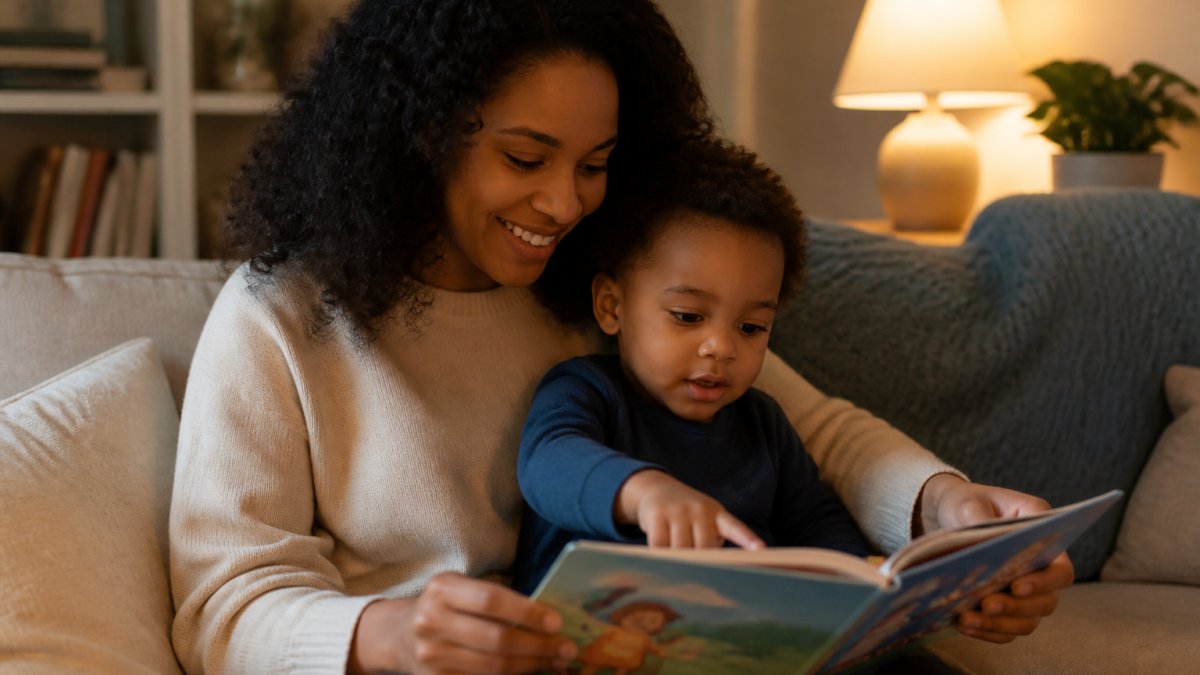
Here is a simple routine that works:
- Pick the same time each day
- Let your child choose the book
- Read with feeling and pause on pictures
- Ask one question at the end
- Keep it to 10 minutes or less
Do not aim for perfect. Aim for steady. A missed night is fine. A missed week is where the habit slips.
If your child wants the same book again, say yes. Repetition is how toddlers learn. It is also how a moral story moves from the page into memory.
Conclusion: Small Stories, Lasting Lessons
The challenge is not finding good stories. It is making reading a steady part of your child's day. Small, repeated moments do more than any single big effort.
At Smokey D Baby Dogga, we built our adventures to make that easy. Our books feature a family of characters, including Rocky the Ghost Dog and Bella the Bat, across ten adventure-themed titles. Each one carries lessons about friendship, courage, and kindness. You can also watch our video trailers to preview a story before you buy.
Visit and subscribe on YouTube to meet Smokey and her friends, and start your next read-aloud tonight.
Frequently Asked Questions
What are the benefits of reading moral stories to toddlers?
Reading moral stories to toddlers supports language development, vocabulary growth, and listening skills while introducing values like kindness, honesty, and sharing. The stories give toddlers a safe way to explore right and wrong through characters they can relate to. Regular storytime also strengthens parent-child bonding and builds early literacy skills that prepare children for reading readiness later on.
How do stories help toddlers learn kindness and empathy?
When a toddler follows a character who helps a friend or shares something special, they practice emotional understanding without real-world pressure. Books like Smokey D Baby Dogga and the Golden Acorn Adventure show Charlie the Chipmunk learning that friendship and kindness lead to good outcomes, which gives toddlers a concrete example to connect to their own behavior.
How long should I read to my toddler each day?
Most toddlers can focus for 5 to 15 minutes at a time, so short daily sessions work better than one long one. Aim for at least one 10-minute storytime per day, and let your child's engagement guide you. If they lose interest, pause and try again later. Consistency matters more than duration for building early literacy and vocabulary.
Can toddlers really understand the lessons in moral stories?
Toddlers understand simple lessons when they are tied to clear actions and emotions, such as a character sharing a toy or helping a friend. They may not grasp abstract ideas like honesty right away, but repetition and questions during reading help them connect the story to real life. Keep explanations short and concrete for the best results.