
How to Choose Positive Values Literature for Preschoolers
Table of Contents
- Why Positive Values Literature Matters for Preschoolers
- A Practical Selection Framework for Choosing Positive Values Literature
- Books About Kindness for Preschoolers: What to Look For
- Finding Age-Appropriate Books for Preschoolers
- How to Read Books With Preschoolers to Reinforce Values
- Representation, Inclusion, and Individual Needs
- Common Mistakes When Choosing Values-Based Stories
- Conclusion: Building a Values Library Your Child Will Love
- Frequently Asked Questions
Last Updated: October 8, 2026
Why Positive Values Literature Matters for Preschoolers
Positive values literature is any children's book that deliberately teaches kindness, honesty, courage, or responsibility through story.
The preschool years are prime time for character development: children this age are learning empathy, sharing, and self-control, and stories give them a safe way to practice. At Smokey D Baby Dogga, we create adventures that put friendship and kindness at the center of every plot.

The American Academy of Pediatrics notes that reading together daily builds both literacy and social-emotional skills. American Academy of Pediatrics literacy guidance
But not every "values" book delivers. The best wrap a lesson inside a story so good your child asks for it again.
A Practical Selection Framework for Choosing Positive Values Literature
Choosing positive values literature for preschoolers gets easier with a three-step framework: match the message to your child's stage, check the story's moral complexity, then evaluate how the book looks and reads aloud.
Most parents skip straight to the cover. That's a mistake. Here's how to screen a book in two minutes.
Step 1: Match the Message to Your Child's Stage
A 3-year-old and a 6-year-old need different lessons. Three-year-olds grasp sharing and gentle hands. Five-year-olds can handle fairness and standing up for a friend.
Ask yourself:
- Does the main character face a problem my child recognizes?
- Is the lesson stated simply, or does it need explanation?
- Will my child see themselves in this story?
If any answer is no, keep looking.
Step 2: Check the Story's Moral Complexity
Good values-based stories show a character making a choice, not just following rules, a moment where the character decides to be kind, honest, or brave.
Watch for these signs of a strong story:
- The character struggles before doing the right thing
- The consequence feels real, not preachy
- The lesson comes from the plot, not a lecturing narrator
Books that spell out the moral on every page lose kids fast.
Step 3: Evaluate Illustrations, Language, and Attention Span
Preschoolers judge books by their covers, literally. Bright, clear illustrations hold attention. Cluttered pages overwhelm.
Check these details before you buy:
- Are the pictures large enough to point at from a lap?
- Does the text rhyme or flow when read aloud?
- Can you finish the book in 5-10 minutes?
If your child loses interest by page three, the values won't land no matter how good they are.
Books About Kindness for Preschoolers: What to Look For
Most book lists tell you which kindness books to buy. Almost none tell you how to judge whether a kindness story is doing developmental work for a 3-, 4-, or 5-year-old.
The Core Test: Does Kindness Cost the Character Something?
A story where everyone is nice to everyone teaches nothing. Preschoolers learn values by watching a character choose kindness when a cheaper option is available; if the character has nothing to lose, the child has nothing to learn.
Run any kindness book through these four checks:
- Is there a real want in conflict? The kind character should want something the other character is blocking, a turn with the toy, a spot on the swing, the last cookie. No friction, no lesson.
- Is there a moment of hesitation? Look for a beat where the character pauses, frowns, or looks away before acting. That pause is where preschoolers do their moral processing.
- Is the kind act small and copyable? "She shared her crayons" is copyable at recess tomorrow. "He donated his entire inheritance" is not. Preschoolers need acts they can replicate within a day.
- Does the resolution show the effect on the other character? The reader should see the recipient's face or body change, a smile, a relaxed shoulder, an invitation to play. Cause and effect must be visible, not narrated.
If a book fails two or more of these, it is a pleasant story, not a values story.
Why 'Preachy' Fails and What to Look For Instead
Preachy books tell the child what to conclude; strong books let the child arrive there. Watch for these tells:
- A narrator who moralizes. Lines like "And that is why we always share" do the child's thinking for them. A stronger book ends on an image or dialogue that lets the child feel the outcome.
- A villain with no interior life. If the unkind character is simply "mean," the child learns to label people rather than understand choices. A book where the unkind character is sad, left out, or scared gives the child a reason to care about the change.
- A tidy ending with no cost. If the kind character gives something up and gets it right back on the next page, the lesson evaporates. A small, permanent cost, a lost turn, a shared snack, makes the value stick.
A Quick In-Store Screening Routine
Run this in about 90 seconds with the book in your hands:
- Flip to the middle. Read one spread aloud. If the text moralizes, put it back.
- Find the moment of choice. If you cannot locate it in 30 seconds, the story is too diffuse.
- Check the final spread. If the last line explains the lesson, the book is telling, not showing.
What This Looks Like in Practice
A strong kindness story for a 4-year-old typically runs 400-600 words, has one central conflict, two to four characters, and a resolution that fits on a single spread. The kind act is usually something a child could do at daycare that afternoon, offering a turn, inviting someone into a game, or sharing a snack.
The Same Pattern Applies to Other Values
Kindness is the easiest value to screen because the cost is visible. The same logic extends:
- Honesty stories need a moment of temptation where lying would be easier and the child can feel the pull.
- Courage stories need a character who is genuinely afraid, not merely inconvenienced.
- Responsibility stories need a consequence the character caused and then repaired.
If the conflict is fake, the lesson is too. The test is always the same: can a preschooler point to the moment the character chose?
Finding Age-Appropriate Books for Preschoolers
Age-appropriate books for preschoolers balance simple words with rich ideas. The vocabulary should be easy. The feelings should not be.
Here's a quick guide:
| Age | Story Length | Values They Grasp | What to Avoid |
|---|---|---|---|
| 3-4 | 200-400 words | Sharing, gentle hands, saying sorry | Scary villains, long text blocks |
| 4-5 | 400-700 words | Fairness, friendship, honesty | Abstract morals, heavy dialogue |
| 5-6 | 700-1,000 words | Courage, responsibility, empathy | Complex subplots, subtle irony |
One series can often work for siblings at different ages: a 3-year-old follows the pictures while a 6-year-old tracks the plot.
Smokey D Baby Dogga Magical Forest →
How to Read Books With Preschoolers to Reinforce Values
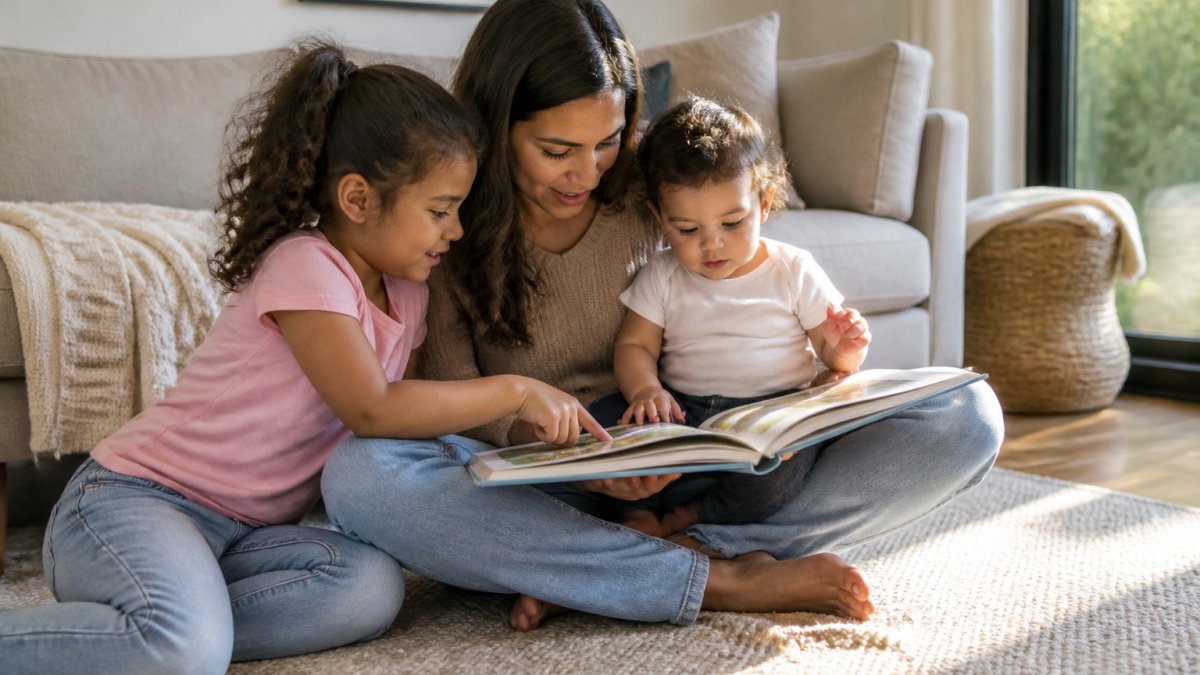
Which book you choose matters less than what happens in the five minutes after you close it. Most read-aloud advice stops at "ask open-ended questions", not enough for a 3- to 5-year-old, who needs concrete, repeatable language and a bridge from the story to their own day.
Why the Post-Reading Window Matters More Than the Story
Preschoolers live in the present. A character's choice on page 12 becomes usable only when the child connects it to something they did or saw today.
A common pattern among early childhood educators is the "one question, one connection, one retell" structure. It takes about three minutes and fits a preschooler's attention span.
The Three-Minute Routine
Minute 1, One question about the character's choice. Ask about the moment of decision, not the plot.
Minute 2, One connection to the child's life. Name a specific, recent moment.
Minute 3, One retell, in the child's words. Ask the child to tell the story back to you, a stuffed animal, or a grandparent on the phone.
Sample Prompts by Age
Ages 3-4 (concrete, feeling-based):
- "How do you think he felt right there?"
- "Was that a kind thing or a not-kind thing?"
- "What did her face look like?"
Ages 4-5 (choice-based, cause-and-effect):
- "Why do you think she decided to do that?"
- "What would have happened if he didn't share?"
- "Have you ever felt like that?"
Ages 5-6 (perspective-taking, gentle abstraction):
- "How do you think the other character felt about it?"
- "Was it hard for her to do the right thing?"
- "What would you have done?"
Avoid "What is the lesson of this story?" at every age. It turns a story into a test, and preschoolers shut down when they sense they are being quizzed.
Read-Aloud Techniques That Carry the Value
How you read matters as much as what you ask.
- Pause at the choice. When the character hesitates, stop for two seconds. Let the child feel the weight. Do not fill the silence.
- Use a different voice for the inner struggle. A quieter, slower voice for the moment of decision signals that something important is happening.
- Point to faces. Preschoolers read emotion in illustrations before text. A finger on a sad face does more than a sentence about sadness.
What to Do When the Child Disagrees
Sometimes a child will say the character should have kept the toy. Don't correct it. Ask, "What do you think would happen next if she did?" Let the child reason forward. The goal is not a correct answer but a habit of thinking about consequences, a child who argues with a book is more engaged than one who nods along.
A Note on Siblings and Mixed Ages
If you are reading to a 3-year-old and a 6-year-old at once, aim your questions at the younger child and let the older one answer the follow-ups. The younger learns from hearing the older reason aloud; the older consolidates the value by explaining it. One book, two developmental jobs.
Representation, Inclusion, and Individual Needs
Children look for themselves in stories. When they find a character who looks or lives like them, the lesson hits harder.
Look for books that show:
- Different family structures and skin tones
- Characters with different abilities
- Boys and girls showing kindness, courage, and empathy equally
Also match books to your child's needs. A shy child benefits from stories about finding your voice. A child who struggles with sharing needs stories where sharing solves the problem.
Common Mistakes When Choosing Values-Based Stories
The biggest mistake is choosing books for the lesson instead of the child. A book your child won't sit through teaches nothing.
Other common missteps:
- Picking books that lecture instead of tell a story
- Ignoring your child's current interests
- Buying too many books at once instead of a few favorites
A common mistake is assuming longer books mean deeper lessons. At this age, shorter and sharper wins.
Conclusion: Building a Values Library Your Child Will Love
Building a values library takes patience, but the payoff lasts for years. Start with one book that fits your child's age and current challenge. Read it often. Talk about it.
At Smokey D Baby Dogga, we built our series around exactly this idea. Titles like Smokey D Baby Dogga Goes To School and Smokey D Baby Dogga Waits for the Mail Lady Ronnie are $14.99 each.

Visit and subscribe to our YouTube channel to meet the characters, then pick the adventure that fits your child best.
Frequently Asked Questions
What is the 5 finger rule for choosing books?
The five finger rule helps you check if a book matches your child's reading level. Have your child read one page and hold up a finger for each word they struggle with. Zero to one fingers means the book is easy, two to three is a good fit, and four or more means it is too hard for now. For preschoolers who are not reading independently, use this rule on the read-aloud text instead. If you stumble over more than five words per page, the language may be too advanced for their attention span.
How can I tell if a book is appropriate for a preschooler?
Look at four things: length, language, illustrations, and emotional weight. Age-appropriate books for preschoolers usually run 24 to 48 pages with one to three sentences per page. The pictures should carry at least half the story so a non-reader can follow along. Check that any conflict resolves within the story and that characters model the behavior you want to see. If a book introduces fear, loss, or moral dilemmas without a clear, comforting resolution, save it for an older child.
How can I talk with my preschooler about a story's message?
Ask open questions instead of quizzing them. Try 'How do you think Charlie felt when he lost his acorn?' or 'What would you do to help a friend?' Pause mid-story to let your child predict what happens next. After reading, connect the lesson to their day: 'Remember when you shared your snack at school? That was kindness, just like Smokey showed.' Keep these conversations short, two or three questions is plenty for a preschooler. The goal is planting the idea, not testing comprehension.
Which values are most helpful to explore through preschool books?
Focus on values a preschooler can act out: kindness, sharing, friendship, honesty, courage, patience, and responsibility. Abstract ideas like justice or integrity are harder for young children to grasp until around age seven or eight. Books about kindness for preschoolers work best when the character makes a clear choice the child can copy, such as helping a friend or telling the truth. Stories that show teamwork and cooperation give children a script for playground situations they already face.