
Engaging Storybooks for 3 Year Olds: 7 Picks for 2026
Table of Contents
- What Makes a Storybook Engaging for a 3 Year Old?
- How to Choose Books for Toddlers: A Simple Framework
- 1. Smokey D Baby Dogga Magical Forest
- 2. Smokey D Baby Dogga and the Golden Acorn Adventure
- 3. Smokey D Baby Dogga Pirate Treasure Ship
- 4. Smokey D Baby Dogga Chocolate Factory Adventure
- 5. Smokey D Baby Dogga Moon Mission
- 6. Smokey D Baby Dogga Goes To School
- Bedtime Stories for 3 Year Olds: Building a Routine That Sticks
- Interactive Storybooks for 3 Year Olds: Reading Beyond the Words
- 7. A Note on Series, Sustainability, and Screen Balance
- Frequently Asked Questions
Last Updated: September 14, 2026
What Makes a Storybook Engaging for a 3 Year Old?
Engaging storybooks for a 3 year old match their attention span, use rhythm and repetition, and pair simple language with illustrations rich enough to hold a wandering gaze. At Smokey D Baby Dogga, we've learned that the books toddlers return to share three traits: a predictable pattern, a recognizable character, and a page they can point at.

The American Academy of Pediatrics recommends daily read-aloud time from infancy, and by age three, most children can follow a simple narrative from start to finish (Beyond Literacy: Shared Reading Starting at Birth Offers Lifelong Benefits).
Below, we break down how to choose books for toddlers, then walk through picks from the Smokey D Baby Dogga Adventures series, each built for ages 3 to 8.
How to Choose Books for Toddlers: A Simple Framework
Choosing well comes down to two filters: how the book looks and reads, and whether it fits your child's attention span.
Look at Illustration Quality and Narrative Structure
Strong picture books for toddlers use clear, uncluttered illustrations with one focal point per page. Busy spreads overwhelm a 3 year old; simple scenes with a recognizable character let them track the story visually while you read aloud. A beginning, a small problem, and a happy resolution fit a toddler's comprehension.
Match the Book to Your Child's Attention Span
A 3 year old typically sits with a book for three to five minutes, so books with one or two short sentences per page respect that limit (Developmental Milestones of Early Literacy). Longer, chapter-style stories work better once a child nears five or six, which is why a series that scales with your child earns its shelf space.
| Age | Typical Attention Span | Best Book Format |
|---|---|---|
| 2-3 years | 3-5 minutes | Board books, one line per page |
| 3-4 years | 5-8 minutes | Picture books, short sentences |
| 5-6 years | 10-15 minutes | Longer picture books, simple plots |
| 7-8 years | 20+ minutes | Early readers, short chapters |
1. Smokey D Baby Dogga Magical Forest
Best for: gentle bedtime reading with a kindness theme. Smokey and friends, including Rocky the Ghost Dog, Bella the Bat, and Oliver the Wise Owl, travel hidden paths and glowing fireflies, landing on friendship, courage, and helping others without feeling preachy.
The illustrations give a 3 year old plenty to point at, and at $14.99 it works as a read-aloud for the youngest listeners while still holding a 6 year old's interest.
2. Smokey D Baby Dogga and the Golden Acorn Adventure
Best for: teaching persistence. When Charlie the Chipmunk loses his Golden Acorn, Smokey and Finn the Bluebird help him chase a dream that looks lost, and the message that even the smallest seed can grow into something amazing gives parents a natural talking point.
At $14.99, it's a solid pick for conversations about teamwork and hope.
3. Smokey D Baby Dogga Pirate Treasure Ship
Best for: kids who want action. A treasure map, a ship, hidden caves, and a hunt for Treasure Paw Island make this the adventure-forward title in the series, with challenges solved through cooperation so the excitement never costs the values you want reinforced.
4. Smokey D Baby Dogga Chocolate Factory Adventure
Best for: sensory engagement and pure fun. Chocolate rivers and sweet surprises carry the story, with lessons about kindness, teamwork, and sharing underneath, the kind of book a toddler asks for again because the setting itself is delicious.
5. Smokey D Baby Dogga Moon Mission
Best for: curiosity and big dreams. Smokey suits up as an astronaut, travels to the Moon, explores craters, and plants a flag, turning courage and never giving up into something concrete and visual for a space-fascinated 3 year old.
6. Smokey D Baby Dogga Goes To School
Best for: easing first-day nerves. Meeting classmates, exploring classrooms, and learning kindness, teamwork, and respect frame school as a place to grow. If your child starts preschool or pre-K, reading it beforehand helps normalize the transition.
Bedtime Stories for 3 Year Olds: Building a Routine That Sticks
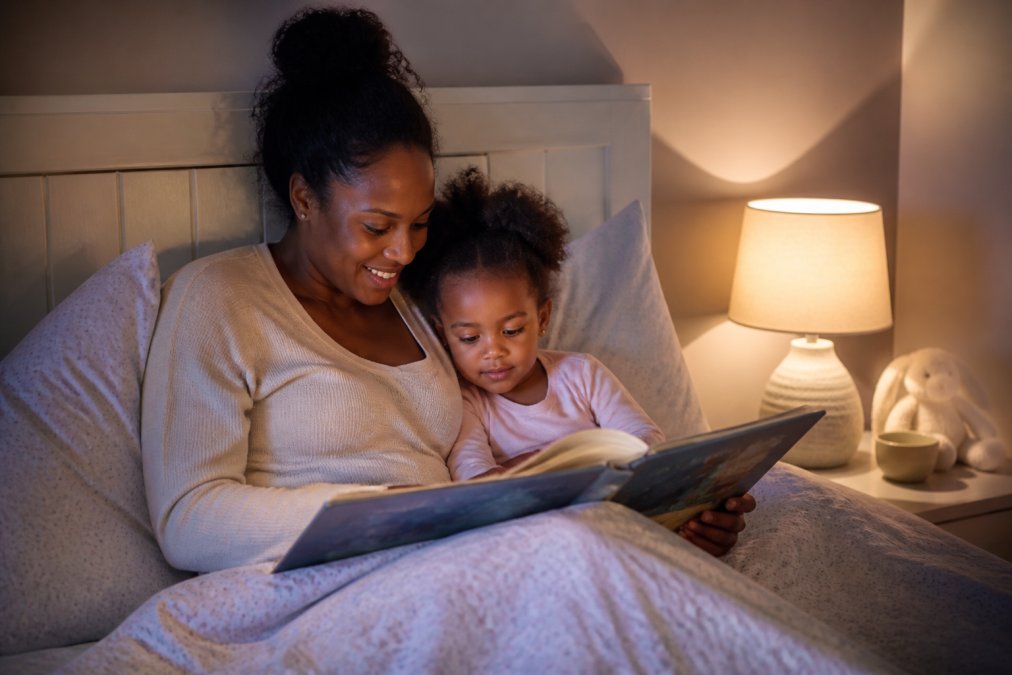
Bedtime stories for 3 year olds work best when predictable: same time, same spot, same wind-down rhythm. A short, familiar book signals the day is closing, and repeating the same few titles strengthens vocabulary because your child hears the same words in the same context night after night.
Pair the routine with a reading companion. The Smokey D Baby Dogga & Friends Bookmark at $11.99 gives kids something tactile to hold and helps them feel ownership over "their" place in the story.
Interactive Storybooks for 3 Year Olds: Reading Beyond the Words
Interactive storybooks for 3 year olds turn a passive listen into a two-way exchange, which keeps a short attention span engaged. You don't need flaps and buttons, you need a technique, and the one with the strongest research base is dialogic reading.
What Dialogic Reading Actually Is
Instead of reading straight through, you use the book as a conversation starter and let your child become the storyteller, prompting them to talk about what they see.
The method is built on two mnemonics that are easy to remember at bedtime.
PEER, the sequence for a single page:
Visit & Subscribe on YouTube →
- Prompt your child to say something about the picture
- Evaluate what they say ("Yes, that's a bear!")
- Expand on it ("A big brown bear with muddy paws.")
- Repeat the prompt back to check they got it ("Can you say that? A big brown bear.")
CROWD, the five prompt types to rotate through:
- Completion, pause before the last word of a rhyming line and let them fill it in
- Recall, "Do you remember who helped Smokey find the path?"
- Open-ended, "What's happening on this page?"
- Wh- questions, "Where is Bella the Bat hiding?"
- Distancing, "Remember when you helped your friend at the park?"
How to Run It Without a Meltdown
Parents often try dialogic reading once, get a blank stare, and quit. The fix is scaffolding, start with the easiest prompt type and only move up when your child answers easily.
Try these during your next read-aloud:
- Start with completion prompts on a book your child already knows by heart
- Point to a character and ask, "How do you think she feels right now?"
- Make a sound effect for each page turn and invite your child to copy it
- Ask your child to find a specific object in the illustration
- Follow their lead, if they fixate on one page, stay there and ask more about it
If your child refuses to answer, don't push, answer it yourself and ask again on the next page. Most 3 year olds need a prompt modeled several times before they respond.
Choosing Books That Support the Technique
The best engaging storybooks share three features: illustrations with clear, nameable objects; a repeating refrain your child can complete; and a simple emotional arc you can ask about. Wordless picture books also work well because no text competes with the conversation.
This is why a series with recurring characters, like Smokey, Rocky the Ghost Dog, and Bella the Bat, pays off. Your child already knows who they are, so recall and distancing prompts ("What did Rocky do last time?") land instead of confusing them. The same title can be read straight through at 3 and used for richer back-and-forth at 4 and 5.
7. A Note on Series, Sustainability, and Screen Balance
One more book rounds out the collection, plus two angles most best-of lists skip: sensory-friendly reading for neurodivergent kids, and balancing physical books against screens and audio.
The Smokey D Baby Dogga series runs ten adventure-themed titles, plus companion items like the coloring book at $12.95 and the jigsaw puzzle at $27.99. Each book page includes a QR code linking to video trailers and more Smokey D Baby Dogga content, which lets you extend the story on screen in a controlled way rather than handing over a tablet.


Sensory-Friendly Picks for Kids Who Process Differently
Most "best books for 3 year olds" lists assume a neurotypical reader. If your child is autistic, has ADHD, or is sensitive to sensory input, the criteria shift. Patterns parents and early intervention providers report work well:
- Low-contrast, uncluttered art. Busy spreads with dozens of background details can overwhelm a child who struggles with visual processing. One focal point per page is the rule.
- Predictable, repetitive text. A repeating refrain gives a child a reliable anchor and reduces the cognitive load of tracking a new plot on every page.
- Familiar characters across titles. A series beats a stack of standalones here, the child doesn't have to re-learn who everyone is each night.
- Tactile or interactive elements. Board books with textured patches, sturdy lift-the-flaps, and chunky page edges give a sensory-seeking child something to do with their hands while listening.
- Choice and control. Letting the child pick which of three books to read, or which page to linger on, reduces the power struggle that can end storytime early.
A useful rule of thumb: if your child covers their ears, turns away, or pushes the book away mid-page, the book is asking too much. Drop to a shorter, simpler title and try the longer one again in a few months.
Physical Books, Audio, and Screens: A Balanced Media Diet
Physical books build focus, fine motor skills (page turning), and a tactile association with reading that carries into early literacy, but audio and video still have a place.
A workable balance for a 3 year old:
- Physical picture book as the core of the bedtime routine, the default, most nights
- Audiobook or read-along for car rides, rest time, or when a parent is unavailable, good for vocabulary exposure, weaker for print awareness
- Short video preview or animated read-aloud as an occasional treat tied to a book your child already loves, best used to build anticipation for the next title, not as a replacement for the book itself
The American Academy of Pediatrics recommends avoiding solo screen use for children under 2 and limiting screen time for ages 2 to 5 to about one hour per day of high-quality programming, ideally co-viewed with a caregiver (Kids & Screen Time: How to Use the 5 C's of Media Guidance).
Sustainability Without the Preachiness
For sustainability-minded families, a durable hardcover series passed down or shared across siblings beats disposable novelty books. Look for paper stock and binding that survive toddler handling, and pass finished titles along. Markers of a book built to last:
- Sewn or reinforced binding rather than glued-only spines
- Thick, coated paper stock that resists tearing and wiping
- Board-book editions of favorites for the youngest, roughest readers
- A series format, so a single purchase decision covers years of reading rather than one season
Used bookstores, library sales, and hand-me-downs stretch the same dollar further and keep paper in circulation. The goal isn't a perfect eco-credit score, it's buying fewer, sturdier books that earn their shelf space for years instead of weeks.
Frequently Asked Questions
What makes a storybook engaging for a 3-year-old?
Engaging storybooks for 3 year olds combine bold, clear illustrations with simple narrative structure and rhythmic language. At this age, children rely on pictures to follow the plot, so illustration quality matters as much as the words. Look for stories with repetition, relatable characters, and emotional stakes a toddler can grasp, like losing a toy or making a friend. Books that invite participation, such as asking your child to point at objects or predict what happens next, hold attention longer than passive read-alouds.
How do I choose books for toddlers who have a short attention span?
Start with books under 300 words and build from there. A 3-year-old typically follows a story for 5 to 10 minutes, so a picture book with one clear arc works better than a longer anthology. Choose interactive storybooks for 3 year olds with lift-the-flap elements, texture patches, or repeated phrases your child can chime in on. If attention wanders, stop reading and ask a question about the picture instead of pushing through. Short, positive sessions build the habit faster than long ones.
Are interactive books good for 3-year-olds?
Yes. Interactive elements like flaps, touch-and-feel panels, and search-and-find prompts support sensory engagement and comprehension at this age. They turn storytime into a two-way activity, which helps toddlers connect words to actions and objects. That said, the story still needs a clear narrative structure underneath the interactive features. A book with pop-ups but no real plot loses its appeal after two readings. Balance is what keeps a child returning to the same title.
How long should a storybook be for a 3-year-old?
Most 3-year-olds do well with picture books between 200 and 500 words, roughly 24 to 32 pages with one or two sentences per spread. Board books and shorter hardcovers suit children still developing their attention span, while longer picture books work for kids who already sit through a full bedtime routine. The right length is the one your child can finish without losing interest. If they ask for the same book again, the length is working.
What are the benefits of reading bedtime stories for 3 year olds daily?
A consistent bedtime routine that includes reading supports vocabulary acquisition, comprehension, and emotional regulation. Daily read-alouds expose children to sentence patterns and new words they would not hear in everyday conversation. The routine itself also signals that sleep is coming, which can reduce bedtime resistance. Beyond language, shared reading builds empathy as children follow characters through sharing, compromise, and curiosity. Ten minutes a night adds up to thousands of words heard over a year.