
Books That Spark Imagination for Kids
Table of Contents
- Why Books That Spark Imagination Matter for Early Childhood Development
- Educational Storybooks With Video Trailers: A New Way to Preview Adventures
- Picture Books and Adventure Stories That Encourage Creative Thinking
- How to Foster Imagination Through Reading: Parent and Caregiver Strategies
- Books That Encourage Creative Play Beyond the Page
- Interactive Activities and Merchandise to Extend the Story
- Building a Home Library for Imagination and Wonder
- Conclusion
Last Updated: August 22, 2026
Why Books That Spark Imagination Matter for Early Childhood Development
Books that spark imagination are foundational tools for cognitive and emotional growth. When children encounter stories that encourage creative thinking, they're building neural pathways for problem-solving, empathy, and self-expression that extend well beyond the page.
The developmental window between ages 3 and 8 is critical (peer-reviewed research). During these years, children's brains are primed for narrative learning, visual literacy, and imaginative play (the NIH). Picture books and adventure stories activate multiple learning systems simultaneously: language acquisition, visual processing, emotional recognition, and the ability to envision worlds beyond their immediate experience (peer-reviewed research).
What makes a book truly spark imagination is the invitation to wonder. The best stories leave space for children to fill in details, imagine character voices, and extend narratives into their own play. Interactive reading, where parents pause to ask "What do you think happens next?" transforms a passive experience into active cognitive engagement.
At Smokey D Baby Dogga, we've built our entire story collection around this principle: every adventure is designed to ignite curiosity while teaching friendship, kindness, and courage. The characters become companions in a child's imaginative world, extending far beyond the final page into toys, merchandise, and future animated adventures.

Below, we'll explore the specific types of books that fuel creative thinking, practical strategies parents can use to deepen the reading experience, and how to build a home library that grows with your child's imagination.
Educational Storybooks With Video Trailers: A New Way to Preview Adventures
Educational storybooks have evolved beyond static illustrations. Many modern children's publishers now offer video trailers that preview stories before purchase, allowing families to decide which books to invest in. These trailers give children a taste of characters, settings, and tone, building anticipation and ensuring the story will capture their attention.
The Smokey D Baby Dogga series exemplifies this approach. Each book comes with an official video trailer available on YouTube, allowing families to preview adventures before committing to a purchase. This matters because children's preferences are specific: a 4-year-old might be captivated by a story about space exploration while finding a gentle forest tale boring. Video previews eliminate guesswork.

What these trailers accomplish:
- Visual introduction to characters and their personalities
- Preview of the illustration style and tone
- Glimpse of the adventure's setting and themes
- Immediate sense of whether the pacing matches your child's attention span
For families with multiple children spanning ages 3-8, this preview mechanism is invaluable. A 3-year-old might prefer the gentler rhythm of Smokey D Baby Dogga Goes To School, while a 7-year-old gravitates toward the action-packed Moon Mission adventure. Watching trailers together lets each child self-select stories that genuinely excite them.
Picture Books and Adventure Stories That Encourage Creative Thinking
Picture books remain the gold standard for sparking imagination in young readers. The marriage of illustration and text creates a unique cognitive experience: children aren't just reading words, they're interpreting visual narratives, noticing details, and imagining the spaces between scenes.
The best picture books for creative thinking show rather than explain. Rather than telling a child "Smokey was brave," the illustrations demonstrate Smokey facing a challenge, hesitating, then moving forward. Children internalize these character moments, then replay them in their own imaginative play.
Space Exploration and Discovery
Stories about space tap into a fundamental childhood drive: the desire to explore the unknown. When Smokey D Baby Dogga travels to the Moon in an astronaut suit, young readers aren't just learning about craters and gravity. They're practicing the mental act of imagining themselves in extraordinary places, solving problems in unfamiliar environments, and pushing past fear.
Smokey D Baby Dogga Moon Mission ($14.99) positions space exploration as an adventure driven by curiosity and courage. The narrative shows Smokey discovering the wonders of outer space while learning that big dreams require teamwork and persistence. For children ages 5-8, this story becomes a springboard for imaginative play: bedroom floors transform into lunar landscapes, stuffed animals become fellow astronauts, and bedtime conversations shift to "What would we discover on Mars?"
Magical Worlds and Wonder
Magical worlds invite children into narrative logic entirely divorced from the real world. The Magical Forest in Smokey D Baby Dogga Magical Forest ($14.99) operates on dream logic: hidden paths appear, fireflies glow with purpose, and woodland creatures offer wisdom. When children navigate magical worlds through stories, they're learning to track multiple layers of meaning and symbolic thinking.
The characters in magical stories, Rocky the Ghost Dog, Bella the Bat, Oliver the Wise Owl, embody archetypal roles that children recognize intuitively. This familiarity creates safety within the strangeness, allowing young readers to lean into wonder without anxiety.
Real-World Adventures and Learning
Not all imagination requires fantasy. Real-world adventures ground creative thinking in achievable scenarios that children can actually explore. Smokey D Baby Dogga Amazing Trip Around the World ($14.99) combines travel, cultural discovery, and friendship within a framework of genuine geography and real destinations.
These stories matter because they expand a child's sense of possibility. A child who reads about Smokey meeting new friends in different countries develops curiosity about other places, cultures, and ways of living. Real-world adventure stories also teach practical imagination: how to navigate unfamiliar places, how to communicate across differences, and how to find wonder in ordinary moments.
How to Foster Imagination Through Reading: Parent and Caregiver Strategies
The book itself is only half the equation. How parents and caregivers engage with stories determines whether reading becomes a passive experience or an active imaginative practice.

Pause during reading to ask genuine questions that extend imagination: "What do you think Smokey will do next?" or "If you were in the Magical Forest, what would you want to discover?" These pauses transform reading from a linear experience into a collaborative storytelling session.
Use character voices. When Smokey speaks, give her a distinct voice. When Rocky the Ghost Dog appears, shift your tone. Children absorb these vocal distinctions and will recreate them in their own imaginative play, deepening their engagement with the character.
Connect stories to real life. After reading Smokey D Baby Dogga Goes To School, talk about your child's own school experiences. What was their first day like? Did they make new friends? This bridge between narrative and reality is where imagination becomes personally meaningful.
Visit & Subscribe on YouTube →
Create story extensions. After finishing a book, ask your child to imagine what happens next. "Smokey's adventure at the lake is over, but what if she went back the next day? What would she do differently?" Record these extensions, write them down, draw pictures, or act them out. You're validating your child's creative thinking and showing that imagination doesn't end when the book closes.
Books That Encourage Creative Play Beyond the Page
The strongest books create characters and worlds that children want to inhabit through play. A well-crafted picture book doesn't end when the last page closes; it begins a new life in the child's imagination, toy collection, and daily conversations.
Smokey D Baby Dogga stories are specifically designed with this extension in mind. The character cast, Smokey, Rocky the Ghost Dog, Bella the Bat, and their friends, are distinct enough that children can differentiate them during pretend play. When children have multiple stories featuring the same characters, their imaginative play deepens. Rather than creating new scenarios from scratch, they're drawing on narrative precedent and practicing narrative sequencing.
The best books for creative play include distinctive character personalities children can embody, recurring settings they can reimagine, themes that connect across stories, open-ended moments where outcomes aren't fully determined, and visual details children can recreate through drawing, building, or pretend play.
Interactive Activities and Merchandise to Extend the Story
Books are the entry point, but merchandise and interactive activities deepen engagement. This isn't about commercialism; it's about recognizing that children learn and imagine through multiple modalities.
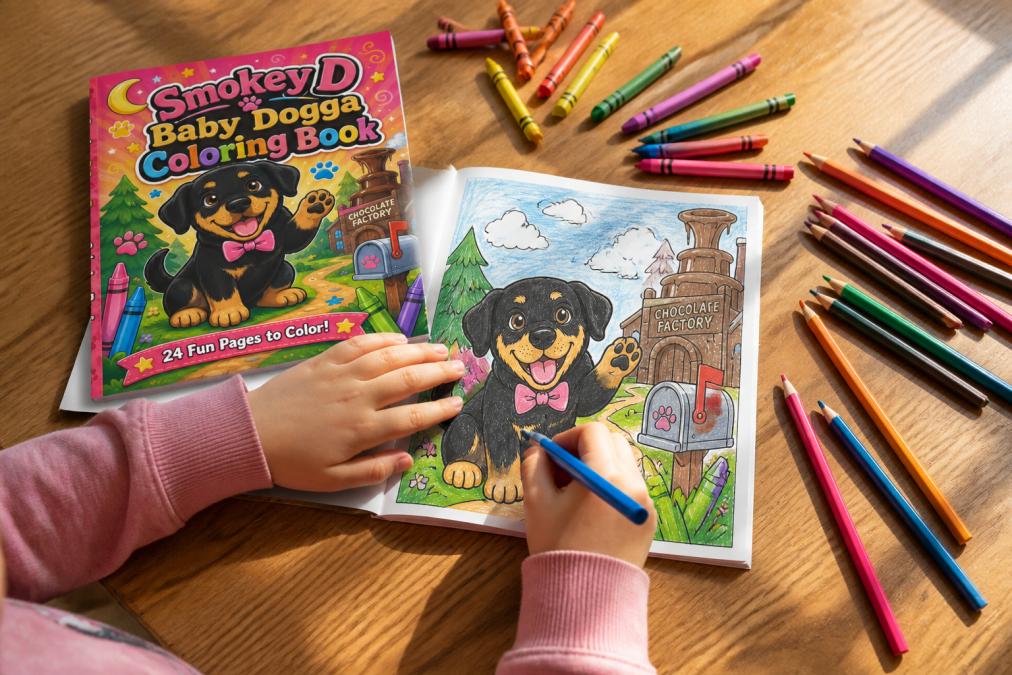
The Smokey D Baby Dogga Coloring Book ($12.95) with 24 fun coloring pages transforms passive reading into active creation. When a child colors Smokey's adventures, they're making aesthetic choices about which colors feel right for the Magical Forest or what shade the Moon should be. This is creative thinking in action.
Puzzles like the Smokey D Baby Dogga and Friends Kids Jigsaw Puzzle ($27.99) in multiple piece counts (110, 252, 520, or 1014 pieces) serve a different cognitive function. Assembling a puzzle of Smokey and friends requires spatial reasoning, pattern recognition, and persistence. The multiple piece-count options mean the puzzle grows with your child.
Merchandise extends character connection beyond reading. A child wearing a Smokey D Baby Dogga shirt becomes an ambassador for their favorite characters. These objects become conversation starters and confidence boosters.
Building a Home Library for Imagination and Wonder
A home library curated for imagination doesn't require hundreds of books. It requires intentional selection: stories that genuinely spark wonder, that represent diverse characters and experiences, and that invite repeated reading.
The Smokey D Baby Dogga series offers a natural foundation for an imagination-focused library. Ten distinct adventure-themed books ($14.99 each) cover diverse settings and themes:
| Book Title | Theme | Best Age | Why It Sparks Imagination |
|---|---|---|---|
| Magical Forest | Wonder, friendship, kindness | 3-7 | Enchanted setting invites exploration and magical thinking |
| Moon Mission | Courage, curiosity, dreams | 5-8 | Space exploration taps into natural desire to discover the unknown |
| Amazing Trip Around the World | Learning, diversity, discovery | 4-8 | Real-world travel expands sense of possibility |
| Cooking Adventure | Teamwork, creativity, sharing | 3-7 | Relatable activity combined with imaginative fun |
| Chocolate Factory Adventure | Imagination, wonder, friendship | 4-8 | Whimsical setting inspired by classic imaginative literature |
| Christmas Adventure on the Polar Express | Magic, generosity, belief | 4-8 | Holiday-specific wonder with timeless themes |
| Lake Adventure | Nature, exploration, friendship | 3-7 | Outdoor setting encourages real-world exploration |
| Goes To School | Confidence, new experiences, kindness | 3-6 | Addresses common childhood transition with positive messaging |
Beyond the Smokey D Baby Dogga collection, a well-rounded imagination library includes picture books with stunning illustrations, stories featuring diverse characters and family structures, narratives that celebrate different types of intelligence and creativity, and books that invite participation.

Organize your home library so children can see and access books independently. When a 5-year-old can scan the shelf and think "I want to read about space today," they're developing agency in their reading choices. This autonomy deepens imaginative engagement.
Rotate books seasonally. A child who reads Christmas Adventure on the Polar Express in December might not pick it up again until November. Pulling it from storage in late autumn reconnects them with the story and characters, creating cyclical engagement rather than one-time reading.
Building a home library for imagination is an investment in how your child thinks, dreams, and understands the world. When children grow up surrounded by stories that celebrate curiosity, kindness, and courage, they internalize these values as normal.
Start with the Smokey D Baby Dogga series, ten distinct adventures designed specifically to spark imagination while teaching friendship and kindness. Watch the video trailers together to let your child preview which stories excite them most. Pair books with interactive activities like the coloring book or puzzle to deepen engagement. Visit the Smokey D Baby Dogga YouTube channel to subscribe and discover new content as it's released. Your child's imagination is waiting.
Frequently Asked Questions
How can reading books help develop a child's imagination?
Reading books activates children's minds to visualize characters, settings, and adventures. When kids encounter picture books and storytelling, they create mental images that go beyond what's on the page. This cognitive engagement strengthens creative thinking, problem-solving skills, and the ability to envision possibilities. Stories like those featuring Smokey D Baby Dogga encourage children to imagine themselves in fantastical worlds, fostering curiosity and wonder that extends into everyday play and learning.
What are the best books for increasing creativity in children ages 3-8?
Books that spark imagination work best when they combine engaging characters, vivid illustrations, and themes of adventure and discovery. Educational storybooks with video trailers allow children to preview stories before reading, building anticipation and engagement. Adventure-themed books featuring magical forests, space missions, and real-world explorations encourage creative thinking. Stories centered on kindness, friendship, and problem-solving inspire children to think beyond the narrative and apply imaginative solutions to their own experiences.
How do I choose books that encourage creative thinking for my child?
Look for books with colorful, detailed illustrations that invite close observation and discussion. Choose stories featuring characters on adventures or facing challenges that require imagination to solve. Educational storybooks with accompanying video trailers help you preview content and gauge whether it matches your child's interests. Consider your child's age and attention span, picture books work well for toddlers and preschoolers, while more complex narratives suit older early readers. Books that celebrate storytelling, wonder, and discovery naturally spark imagination more effectively than purely instructional texts.
Why is imaginative play important for early childhood development?
Imaginative play builds cognitive, emotional, and social skills during critical developmental years. When children engage with stories that spark imagination, they develop narrative skills, expand vocabulary, and strengthen reading comprehension. Creative play based on books teaches problem-solving, emotional regulation, and collaboration. Books that encourage pretend play and creative expression help children process emotions, build confidence, and develop resilience. Stories featuring diverse characters and themes of kindness foster empathy and cultural awareness, laying the foundation for healthy social-emotional growth.
Can one book series work for children of different ages, like a 3-year-old and a 7-year-old?
Yes, well-designed book series can engage multiple ages through layered storytelling and illustrations. Picture books with simple narratives appeal to younger children, while older readers find deeper themes about friendship, courage, and discovery. Books that encourage creative play work across ages because imagination doesn't have a ceiling. The Smokey D Baby Dogga series features adventure-themed stories that toddlers enjoy for colorful characters and simple plots, while preschoolers and early readers engage with more complex themes and character development. Reading together allows siblings to experience stories at different levels while sharing the same magical world.
This article was written using GrandRanker