
7 Creative Reading Activities for Elementary Students
Table of Contents
- 1. Phonics Treasure Hunt: Decoding Skills in Motion
- 2. Vocabulary Charades: Acting Out New Words
- 3. Story Map Builders: Hands-On Comprehension Strategy
- 4. Reading Activities That Motivate Reluctant Readers
- 5. Creative Book Report Ideas for Kids: Beyond the Worksheet
- 6. Educational Storybooks with Video Trailers: A Hybrid Reading Experience
- 7. Literacy Games for Neurodivergent and Struggling Readers
- Frequently Asked Questions
Last Updated: September 21, 2026
1. Phonics Treasure Hunt: Decoding Skills in Motion
Phonics treasure hunts are reading activities that turn decoding practice into a physical game. You hide letter cards around a room, and your child hunts for them, sounds them out, and builds words as they go.
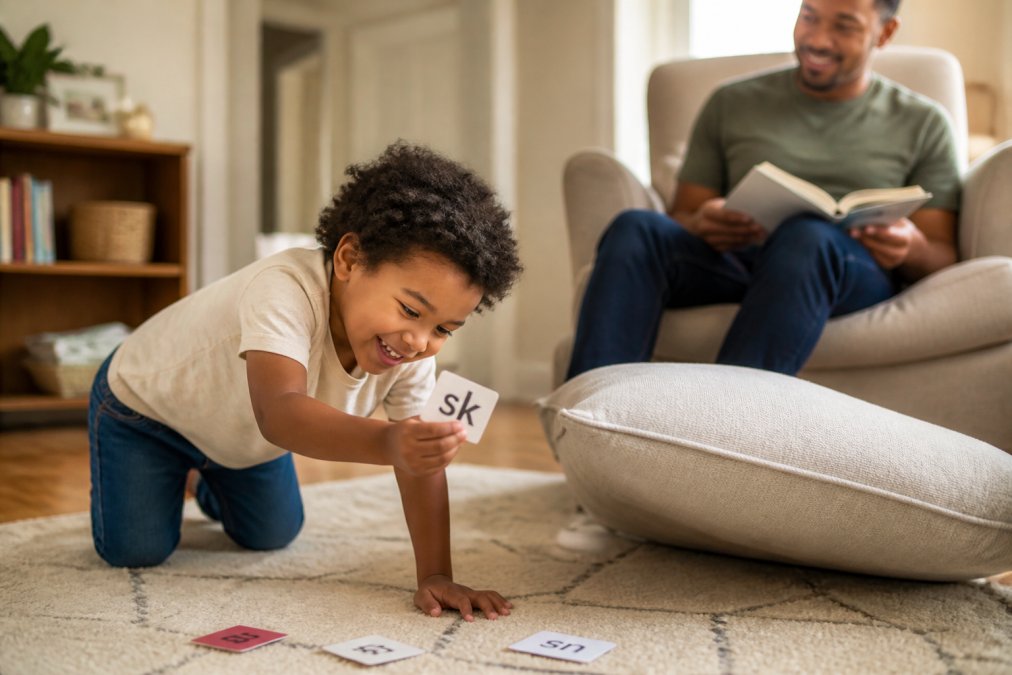
Here's how to run one:
- Write letter blends on index cards
- Hide the cards around one room
- Give your child a word list to complete
- Have them sound out each find and match it to a word
Start with single letters for early readers and move to blends like "sh" or "ch" as they progress.
2. Vocabulary Charades: Acting Out New Words
Vocabulary charades builds word knowledge through movement. Your child draws a word card, acts it out, and the family guesses. The acting cements meaning far better than copying definitions.
3. Story Map Builders: Hands-On Comprehension Strategy
Story map builders turn reading comprehension into a craft project. Your child draws the setting, characters, problem, and solution on a large sheet of paper, then arranges them in order. The reason this works is that retelling is the bridge between decoding words and actually understanding a story, when a child has to place events in sequence, they are practicing the same skill a comprehension quiz measures, just without the pressure of a test.
A simple story map has four boxes:
- Characters: Who is in the story?
- Setting: Where and when does it happen?
- Problem: What goes wrong?
- Solution: How does it get fixed?
Match the Map to the Grade Band
A four-box map is not the right tool for every reader. Scale it up or down:
- Kindergarten and first grade: Use three boxes, beginning, middle, and end, and let your child draw instead of write. Stick figures are fine.
- Second and third grade: Add the four-box map above, plus a fifth box for "my favorite part" so the child has a low-stakes entry point.
- Fourth and fifth grade: Move to a five-part map that includes theme or lesson, and ask for one sentence of evidence from the text for each box.
Fiction vs. Nonfiction Maps
Narrative comprehension and informational comprehension use different structures. For nonfiction, swap the problem/solution boxes for:
- Main idea: What is this text mostly about?
- Three supporting details: What facts back it up?
- Something I already knew: How does it connect to prior knowledge?
- Something I want to learn next: What question does it leave you with?
Use the Map as an Informal Assessment
This is the piece most activity lists skip. You do not need a separate quiz to know whether your child understood the story, the map tells you. Watch for these signals:
- Sequence errors: Events out of order usually mean the child read words but did not track the plot.
- Vague characters: "A boy" instead of a name suggests skimming.
- Missing problem: If the child cannot name the conflict, retell the story aloud together before filling in the box.
- Solution that does not match the problem: This is the most common comprehension gap in second and third grade, and it is worth a second read of the ending together.
4. Reading Activities That Motivate Reluctant Readers
Reluctant readers often need a social or playful reason to pick up a book. The two activities below lower the pressure and add a partner, but before you pick an activity, it helps to know which kind of reluctance you are dealing with, because the fix is different for each.
First, Name the Reason
- Skill gap: The child avoids reading because decoding is still hard work. The fix is easier text, not more motivation.
- Attention: The child loses the thread after a page or two. The fix is shorter sessions and movement.
- Anxiety: The child worries about being corrected or judged. The fix is a nonjudgmental audience.
- Interest: The child can read fine but finds the available books boring. The fix is choice, not technique.
Most reluctant readers are a mix of two. Watch for one week before deciding which activity to lead with.
Paired Reading with a Stuffed Buddy
Your child reads aloud to a stuffed animal instead of an adult. The buddy never corrects, never sighs, and never rushes. Many kids relax and read longer because the audience is patient and nonjudgmental. This is the classic anxiety fix, and it works because it removes the performance pressure that makes a struggling reader freeze.
The Two-Minute Book Talk Challenge
Set a timer for two minutes and have your child pitch their book to you like a movie trailer. They describe the characters, the conflict, and why you should read it next. This builds reading motivation because it flips the script. Instead of being tested, your child becomes the expert recommending a story.
Smokey D Baby Dogga Coloring Book – 24 →
- "This book is about..."
- "The main problem is..."
- "You should read it because..."
Adapting Both for Attention and Sensory Needs
If attention is the bottleneck, shorten everything. A two-minute book talk becomes a thirty-second one. Paired reading becomes one page, not one chapter. Add a physical element, a wiggle cushion, a stress ball, or reading while walking around the kitchen table, because movement often improves focus rather than hurting it.
A Quick Progress Check That Does Not Feel Like a Test
Keep a simple tally on your phone or a sticky note: how many minutes did your child choose to read, and how many words did they self-correct without help? Over two or three weeks, you want to see minutes go up and self-corrections go down. That pattern is a far better signal than any single reading level, and it costs you nothing but a note.
5. Creative Book Report Ideas for Kids: Beyond the Worksheet
Creative book report ideas for kids replace the standard summary with something hands-on. Two formats work especially well for elementary students.
Book Report in a Bag
Your child fills a paper bag with five objects that represent the story: a small toy for the main character, a drawing of the setting, and so on. They present the bag and explain each item.
Character Postcard Swap
Your child writes a postcard from one character to another, describing a key event from that character's point of view. Swap postcards with a sibling or friend and guess who wrote to whom.
6. Educational Storybooks with Video Trailers: A Hybrid Reading Experience
Educational storybooks with video trailers combine screen time with page time. A short trailer previews the story, builds curiosity, and hands the child off to the book itself.
7. Literacy Games for Neurodivergent and Struggling Readers
Literacy games for neurodivergent and struggling readers need short rounds, clear rules, and predictable structure. Long open-ended activities lose these readers fast.
Try these adaptations:
- Timed rounds: Keep each round to two or three minutes
- Visual schedules: Show the sequence of the game before starting
- Choice boards: Let the reader pick from three activities
- Movement breaks: Build a stretch or walk between rounds
| Reader Need | Game Adaptation | What You Learn |
|---|---|---|
| Short attention span | Two-minute rounds | Decoding speed and accuracy |
| Needs routine | Visual schedule first | Sequencing and recall |
| Sensory seeking | Movement between rounds | Fluency under low stress |
| Anxious about testing | Choice board format | Comprehension in natural play |
Frequently Asked Questions
How can I make reading more fun for elementary students?
Turn reading into a game. Try a phonics treasure hunt where kids find letter cards hidden around the room, or act out vocabulary words in a round of charades. Pair reading with a hands-on activity like building a story map with sticky notes. The goal is to connect books to movement, play, and choice so kids associate reading with excitement rather than a chore.
What are some creative ways to respond to a book?
Skip the standard worksheet. Try a book report in a bag: kids fill a paper bag with five objects that represent characters, setting, or plot points, then present them to the family. Another option is a character postcard swap, where your child writes a postcard from one character to another. Both ideas build comprehension while letting kids create something they are proud to share.
How do you keep elementary students engaged during independent reading?
Give kids a purpose and a partner. A two-minute book talk challenge asks them to share one exciting thing about what they just read with a sibling or stuffed animal. Rotate reading spots around the house, like a pillow fort or a cozy rug corner. Let them choose from a small stack of books rather than one assigned title. Choice and movement keep attention alive.
What are effective literacy activities for reluctant readers?
Start with high-interest topics and low-pressure formats. Graphic novels, joke books, and storybook video trailers can hook kids who avoid chapter books. Try paired reading where you read one page and your child reads the next. For neurodivergent readers, break sessions into five-minute chunks with a sensory break between each. Short, successful sessions build confidence faster than long ones.
How can multimedia and book trailers enhance reading comprehension?
Video trailers give kids a preview of characters and plot before they open the book, which builds background knowledge and reduces the intimidation of a new story. After reading, watching the trailer again helps children connect visuals to what they read. Some storybooks include QR codes linking to trailers, making the transition from screen to page feel natural and exciting for young readers.